
Certification Topics of 1z0-1115-23 Exam PDF Recently Updated Questions
1z0-1115-23 Exam Prep Guide: Prep guide for the 1z0-1115-23 Exam
Oracle 1z0-1115-23 Exam Syllabus Topics:
| Topic | Details |
|---|---|
| Topic 1 |
|
| Topic 2 |
|
| Topic 3 |
|
| Topic 4 |
|
| Topic 5 |
|
NEW QUESTION # 20
What is the role of the Oracle Database Service enterprise application in OracleDB for Azure?
- A. It allows users to log in to the OCI Console with the same Azure credentials for Azure and the OracleDB for Azure portal.
- B. It provides a distributed, scalable, shared-nothing, in-memory, hybrid columnar, query processing engine designed for extreme performance.
- C. It allows you to add database compute servers and storage servers to your system at any time after provisioning.
- D. It creates and manages resources in the Azure subscription, streams OCI Database metrics to Azure App Insights and events to Azure Log Analytics, and configures net-work settings in Azure so that Azure resources can access database resources in OCI.
Answer: D
Explanation:
The Oracle Database Service multitenant application can:
Create and manage resources in the subscription (for example, the custom dashboard, Azure App Insights, and Azure Log Analytics workspaces OracleDB for Azure creates for each provisioned database).
Stream OCI Database metrics to Azure App Insights and events to Azure Log Analytics.
Configure network settings in Azure so Azure resources can access the database resources in OCI.
Submit events to Azure Event Grid.
More read: Preparation and Prerequisites for OracleDB for Azure
NEW QUESTION # 21
What is the primary difference between using Oracle FastConnect with an Oracle partner and using FastConnect with colocation with Oracle?
- A. The method of establishing the physical connection to Oracle Cloud Infrastructure
- B. The geographical locations available for connections
- C. The number of available redundancy models
- D. The type of virtual circuits supported
Answer: A
Explanation:
FastConnect: With an Oracle Partner:
You can establish a FastConnect connection from your on-premise or remote data center to the data center where your Oracle Cloud resources are provisioned by requesting cloud connectivity services from any of Oracle's FastConnect partners. Oracle has integrated the FastConnect service with a geographically diverse set of IP, VPN, and Ethernet network providers and cloud exchanges to make it easy for you to establish a connection to Oracle Cloud services.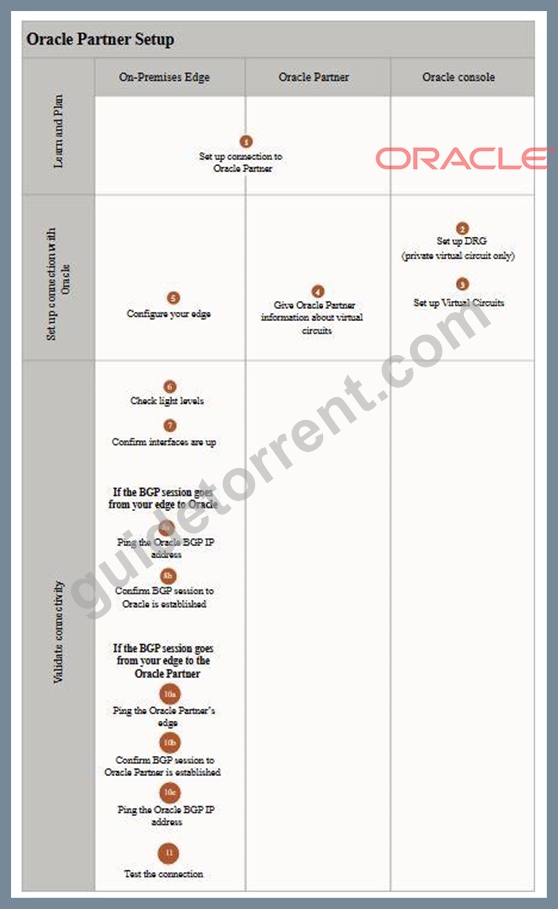
FastConnect: Colocation with Oracle:
If you have purchased colocation space from a data center provider, you can use Oracle FastCon-nect to establish connectivity from your network equipment in that colocation facility to your Oracle Cloud services provisioned at this location. Oracle will provide you a letter of authorization (LOA) that the data center provider will need in order to establish a direct cross-connect into Oracle's FastConnect edge devices provider will need in order to establish a direct cross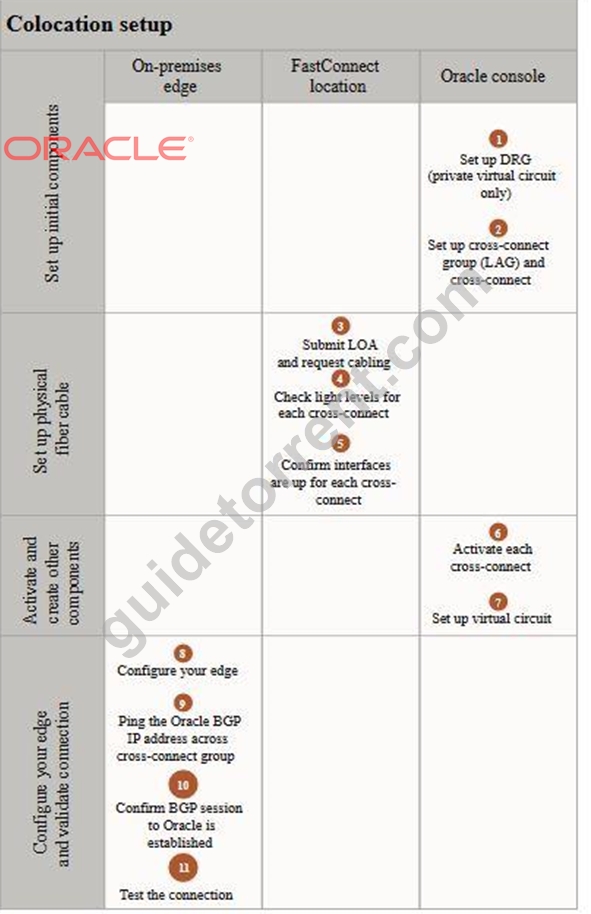
NEW QUESTION # 22
What should you do to prepare your Oracle Cloud Infrastructure (OCI) Virtual Cloud Network (VCN) for potential security risks when connected to a Microsoft Azure VNet?
- A. Remove all OCI security rules.
- B. Allow all traffic from the Azure VNet without restrictions.
- C. Limit all inbound and outbound traffic from the Azure VNet to expected and well-defined traffic.
- D. Disable the connection between Azure VNet and OCI VCN.
Answer: C
Explanation:
Controlling Traffic Flow Over the Connection
Even if a connection has been established between your VCN and VNet, you can control the packet flow over the connection with route tables in your VCN. For example, you can restrict traf-fic to only specific subnets in the VNet.
Controlling the Specific Types of Traffic Allowed
It's important that you ensure that all outbound and inbound traffic with the VNet is intended or expected and well defined. Implement Azure network security group and Oracle security rules that explicitly state the types of traffic one cloud can send to the other and accept from the other.
NEW QUESTION # 23
A company has deployed a multi-tier application in Oracle Cloud Infrastructure (OCI), with web servers in a public subnet and database servers in a private subnet. The database servers need to ac-cess data from OCI Object Storage, and the company wants to ensure that this communication is secure and not exposed to the public internet. Which OCI feature should be used to achieve this objective?
- A. Use a NAT Gateway to enable private access to Object Storage.
- B. Use a VPN Gateway to create an encrypted tunnel to Object Storage.
- C. Use a Local Peering Gateway to peer with the Object Storage subnet.
- D. Use a Service Gateway to establish a secure connection to Object Storage.
Answer: D
Explanation:
A service gateway lets your virtual cloud network (VCN) privately access specific Oracle services without exposing the data to the public internet. No internet gateway or NAT gateway is required to reach those specific services.
The resources in the VCN can be in a private subnet and use only private IP addresses. The traffic from the VCN to the Oracle service travels over the Oracle network fabric and never traverses the internet.
NEW QUESTION # 24
What encryption protocol is used to secure data transmission in an OCI Site-to-Site VPN connec-tion?
- A. Secure Sockets Layer (SSL)
- B. Transport Layer Security (TLS)
- C. Datagram Transport Layer Security (DTLS)
- D. Internet Protocol Security (IPSec)
Answer: D
Explanation:
Site-to-Site VPN provides a site-to-site IPSec connection between your on-premises network and your virtual cloud network (VCN). The IPSec protocol suite encrypts IP traffic before the packets are transferred from the source to the destination and decrypts the traffic when it arrives.
NEW QUESTION # 25
What is the primary Oracle Cloud Infrastructure region associated with an OCI account during Ora-cleDB for Azure setup?
- A. The region specified during OracleDB for Azure onboarding
- B. The home region of the OCI account
- C. The region with the lowest latency for Azure communication
- D. The region with the most available resources for OracleDB for Azure
Answer: A
Explanation:
Identify the primary OCI region you want to use as your default region for OracleDB for Azure resource provisioning.
During OracleDB for Azure setup, this region becomes the primary OCI region associated with your OCI account.
NEW QUESTION # 26
What is the primary purpose of the MySQL Database Service HeatWave option in Oracle Cloud Infrastructure (OCI)?
- A. To provide a distributed in-memory query accelerator
- B. To enable seamless database migration from on-premises to OCI
- C. To offer a serverless MySQL deployment
- D. To ensure high availability and fault tolerance
Answer: A
Explanation:
HeatWave is an in-memory query accelerator developed for Oracle MySQL Database Service. It's a massively parallel, hybrid, columnar, query-processing engine with state-of-art algorithms for distributed query processing which provide very high performance for queries.
NEW QUESTION # 27
In the context of Oracle FastConnect, what are the two types of virtual circuits?
- A. Standard and High-Performance
- B. Private and Public
- C. Intra-Region and Inter-Region
- D. Layer 3 and Layer 4
Answer: B
Explanation:
VIRTUAL CIRCUIT is an isolated network path that runs over one or more physical network connections to provide a single, logical connection between the edge of your existing network and Oracle Cloud Infrastructure. Private virtual circuits support private peering, and public virtual circuits support public peering.
NEW QUESTION # 28
Which is NOT a security capability available with OracleDB for Azure?
- A. Automatic security updates for the database
- B. IPsec tunnel
- C. Encryption of data at rest and in transit
- D. Security features such as network isolation and access controls
Answer: B
NEW QUESTION # 29
What is a key benefit of using Oracle Autonomous Database on Shared Exadata Infrastructure?
- A. Dedicated hardware resources for each database
- B. Unlimited storage capacity
- C. Seamless integration with third-party cloud providers
- D. Automatic database tuning and patching
Answer: D
Explanation:
With Autonomous Database on shared Exadata infrastructure, you do not need to configure or manage any hardware or install any software. Autonomous Database handles provisioning the data-base, backing up the database, patching and upgrading the database, and growing or shrinking the database. Autonomous Database is a completely elastic service.An autonomous database is a cloud database that uses machine learning to automate database tuning, security, backups, updates, and other routine management tasks traditionally performed by DBAs.
NEW QUESTION # 30
What does the term "multicloud" mean and how can it help organizations manage their IT infra-structure?
- A. The integration of on-premises infrastructure with cloud services for a hybrid cloud approach
- B. The use of multiple cloud services from a single provider for redundancy and high availability
- C. The deployment of a single cloud service across multiple regions and data centers for better performance
- D. The use of cloud services from multiple providers to leverage the best features and ser-vices of each
Answer: D
Explanation:
The keyword here is multiple providers. Multicloud is a cloud computing strategy that uses the best services from more than one cloud provider to deploy a solution.
The use of multiple cloud services from a single provider for redundancy and high availability is INCORRECT as it talks about single provider.
The deployment of a single cloud service across multiple regions and data centers for better perfor-mance is also INCORRECT as there is no mention of multiple cloud service providers. Rather it talks about single cloud service across multiple regions.
The use of multiple cloud services from a single provider for redundancy and high availability is al-so INCORRECT as it also talks about single provider.
Hence the correct answer is The use of cloud services from multiple providers to leverage the best features and services of each.
NEW QUESTION # 31
A consulting company that employs Oracle Cloud Infrastructure (OCI) architects has successfully completed resource migration from Microsoft Azure to OCI, and no longer requires the Oracle FastConnect circuit to Azure. The project manager has asked you to delete all resources involved in this cross-cloud connectivity. From the Azure side, you delete the Resource Group. After a while, you notice that all Azure resources have been deleted, except for the Azure ExpressRoute circuit.
What could be a potential reason for this issue?
- A. You need to remove all routes that point to the cross-cloud connection on both OCI and Azure before you can delete the circuit.
- B. Your bill from the OCI side needs to be paid in full before you can remove the Azure ExpressRoute circuit.
- C. You need to first delete the Oracle FastConnect circuit for the ExpressRoute circuit to be decommissioned, and then you can delete the ExpressRoute virtual circuit.
- D. You need to remove the Azure ExpressRoute Partner Service Key from the Oracle FastConnect circuit, and then you can delete the ExpressRoute virtual circuit.
Answer: C
Explanation:
To delete the interconnect, perform these steps in the order given. Failure to do so results in a failed state ExpressRoute circuit.
1. Delete the ExpressRoute connection. Delete the connection by selecting the Delete icon on the page for your connection.
2. Delete the Oracle FastConnect circuit from the Oracle Cloud Console.
3. Once the Oracle FastConnect circuit has been deleted, you can delete the Azure Ex-pressRoute circuit.
Hence "You need to first delete the Oracle FastConnect circuit for the ExpressRoute circuit to be decommissioned, and then you can delete the ExpressRoute virtual circuit." is the CORRECT AN-SWER.
NEW QUESTION # 32
To achieve high availability in a 2-node RAC DB System in Oracle Cloud Infrastructure, what would you use to distribute your nodes to provide database instance fault isolation?
- A. Availability Domains
- B. Fault Domains
- C. Local region
- D. Remote region
Answer: B
Explanation:
A fault domain is a grouping of hardware and infrastructure within an availability domain.
Fault domains provide anti-affinity: they let you distribute your instances so that the instances are not on the same physical hardware within a single availability domain.
To control the placement of your compute instances, bare metal DB system instances, or virtual machine DB system instances, you can optionally specify the fault domain for a new instance or instance pool at launch time.
NEW QUESTION # 33
Which components are required to establish a cross-cloud connection between Microsoft Azure and Oracle Cloud Infrastructure?
- A. Azure Virtual Network and OCI Virtual Cloud Network
- B. Azure Load Balancer and OCI Load Balancer
- C. Azure ExpressRoute circuit and Oracle FastConnect virtual circuit
- D. Azure Site-to-Site VPN and OCI Site-to-Site VPN
Answer: C
Explanation:
For cross-cloud networking between Oracle Cloud and Microsoft Azure, set up a connection be-tween a FastConnect circuit in Oracle Cloud and an ExpressRoute circuit in Microsoft Azure.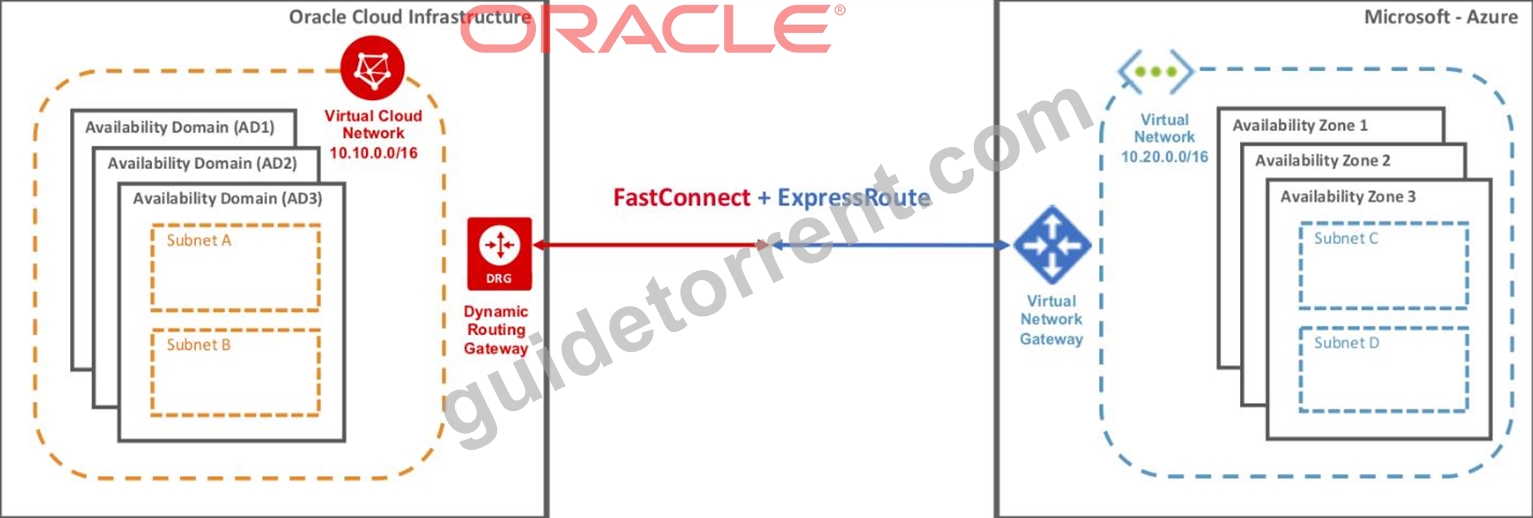
NEW QUESTION # 34
What is the primary Oracle Cloud Infrastructure region associated with an OCI account during Ora-cleDB for Azure setup?
- A. The region specified during OracleDB for Azure onboarding
- B. The home region of the OCI account
- C. The region with the lowest latency for Azure communication
- D. The region with the most available resources for OracleDB for Azure
Answer: A
Explanation:
Identify the primary OCI region you want to use as your default region for OracleDB for Azure resource provisioning.
During OracleDB for Azure setup, this region becomes the primary OCI region associated with your OCI account.
NEW QUESTION # 35
How does Oracle Database Service for Azure enable bidirectional communication between applica-tions in the Azure tenancy and database resources in OracleDB for Azure?
- A. By configuring DNS on both sides of the Interconnect
- B. By federating the Azure tenant's Azure Active Directory (AAD) with an OCI identity domain
- C. By granting the Oracle Database Service enterprise application specific roles in Azure
- D. By creating a custom Azure dashboard for each database
Answer: A
Explanation:
With OCI multicloud's OracleDB for Azure, your database resources reside in an OCI account that is linked to your Azure account through Oracle Interconnect for Microsoft Azure, an Oracle-managed tunnel connection.
OracleDB for Azure configures DNS on both sides of the Interconnect to enable bi-directional communication between applications in the Azure tenancy and database resources in OracleDB for Azure.
NEW QUESTION # 36
An enterprise has a workload running in a VNet in Microsoft Azure and a database running in a VCN in Oracle Cloud Infrastructure. The enterprise wants to set up a private, secure, and isolated network connection between the two clouds to enable traffic flow between the workload and the database. Which option can be used to achieve this requirement?
- A. Use Azure Private Link to create a private connection between the workload and the database.
- B. Use public internet to establish connectivity between the Microsoft Azure VNet and the OCI VCN.
- C. Use Azure VPN and Oracle FastConnect to establish a private and secure tunnel be-tween the Azure VNet and the OCI VCN.
- D. Use Azure ExpressRoute and Oracle FastConnect to create a private interconnection between the Azure VNet and the OCI VCN.
Answer: D
Explanation:
As per the question, the keywords are "The enterprise wants to set up a private, secure, and isolat-ed network connection between the two clouds" Use public internet to establish connectivity between the Microsoft Azure VNet and the OCI VCN - INCORRECT as this option won't provide private, secure and isolated connection.
Use Azure VPN and Oracle FastConnect to establish a private and secure tunnel between the Azure VNet and the OCI VCN is INCORRECT as it won't provide a isolated connection.
Use Azure Private Link to create a private connection between the workload and the database is INCORRECT as Azure Private Link enables you to access Azure PaaS Services (for example, Azure Storage and SQL Database) and Azure hosted customer-owned/partner services over a pri-vate endpoint in your virtual network.
Use Azure ExpressRoute and Oracle FastConnect to create a private interconnection between the Azure VNet and the OCI VCN. is CORRECT. To create an integrated multi-cloud experience, Microsoft and Oracle offer direct interconnection between Azure and Oracle Cloud Infrastructure (OCI) through ExpressRoute and FastConnect. Through the ExpressRoute and FastConnect inter-connection, customers can experience low latency, high throughput, private direct connectivity be-tween the two clouds.
NEW QUESTION # 37
......
2024 New Preparation Guide of Oracle 1z0-1115-23 Exam: https://www.guidetorrent.com/1z0-1115-23-pdf-free-download.html
1z0-1115-23 Practice Exam - 43 Unique Questions: https://drive.google.com/open?id=1wH2MDbw_BUJVaKHsKWEKYBtuuQlErqaA