
Real HP HPE6-A78 Exam Dumps with Correct 110 Questions and Answers
Valid HPE6-A78 Test Answers & HP HPE6-A78 Exam PDF
HP HPE6-A78 exam is an excellent certification for networking professionals who are interested in advancing their careers in network security. Aruba Certified Network Security Associate Exam certification validates the candidate's knowledge and skills in implementing Aruba's security solutions effectively. HPE6-A78 exam covers a wide range of topics related to network security, and passing it demonstrates the candidate's expertise in designing, implementing, and managing secure networks.
Earning the HPE6-A78 certification demonstrates the candidate's commitment to professional development and enhances their career opportunities. Aruba Certified Network Security Associate Exam certification validates the candidate's skills and knowledge in network security and makes them eligible for various job roles such as network security engineer, security consultant, and security analyst. The HPE6-A78 certification is a valuable asset for IT professionals who want to advance their career in network security.
NEW QUESTION # 30
You have a network with ArubaOS-Switches for which Aruba ClearPass Policy Manager (CPPM) is acting as a TACACS+ server to authenticate managers. CPPM assigns the admins a TACACS+ privilege level, either manager or operator. You are now adding ArubaOS-CX switches to the network. ClearPass admins want to use the same CPPM service and policies to authenticate managers on the new switches.
What should you explain?
- A. This approach will work, but will need to be adjusted later if you want to assign managers to the default auditors group.
- B. This approach cannot work because the ArubaOS-CX switches do not support TACACS+.
- C. This approach will work to assign admins to the default "administrators" group, but not to the default
"operators" group. - D. This approach cannot work because the ArubaOS-CX switches do not accept standard TACACS+ privilege levels.
Answer: C
Explanation:
With ArubaOS-CX switches, the use of ClearPass Policy Manager (CPPM) as a TACACS+ server for authentication is supported. The privilege levels assigned by CPPM will translate onto the switches, where the "manager" privilege level typically maps to administrative capabilities and the "operator" privilege level maps to more limited capabilities. ArubaOS-CX does support standard TACACS+ privilege levels, so administrators can be assigned appropriately. If the ClearPass policies are correctly configured, they will work for both ArubaOS-Switches and ArubaOS-CX switches. The distinction between the "administrators" and "operators" groups is inherent in the ArubaOS-CX role-based access control, and these default groups need to be appropriately mapped to the TACACS+ privilege levels assigned by CPPM.
NEW QUESTION # 31
A company has an Aruba solution with a Mobility Master (MM) Mobility Controllers (MCs) and campus Aps.
What is one benefit of adding Aruba Airwave from the perspective of forensics?
- A. AirWave enables low level debugging on the devices across the ArubaOS solution
- B. Airwave can provide more advanced authentication and access control services for the AmbaOS solution
- C. Airwave retains information about the network for much longer periods than ArubaOS solution
- D. Airwave is required to activate Wireless Intrusion Prevention (WIP) services on the ArubaOS solution
Answer: D
NEW QUESTION # 32
What is an Authorized client as defined by ArubaOS Wireless Intrusion Prevention System (WIP)?
- A. a client that is on the WIP whitelist.
- B. a client that has a certificate issued by a trusted Certification Authority (CA)
- C. a client that is not on the WIP blacklist
- D. a client that has successfully authenticated to an authorized AP and passed encrypted traffic
Answer: D
NEW QUESTION # 33
Refer to the exhibit, which shows the current network topology.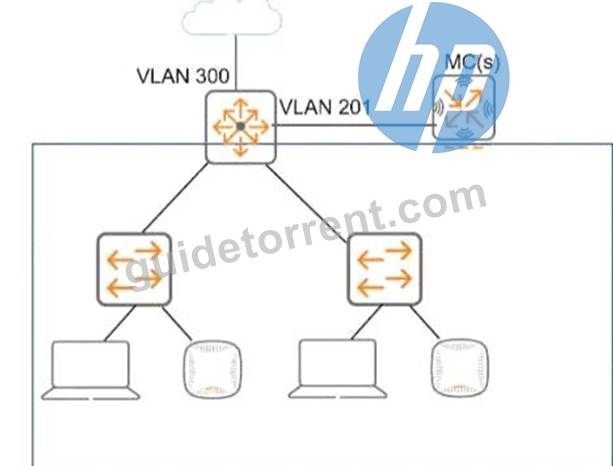
You are deploying a new wireless solution with an Aruba Mobility Master (MM). Aruba Mobility Controllers (MCs). and campus APs (CAPs). The solution will Include a WLAN that uses Tunnel for the forwarding mode and Implements WPA3-Enterprise security What is a guideline for setting up the vlan for wireless devices connected to the WLAN?
- A. Assign the WLAN to a single new VLAN which is dedicated to wireless users
- B. Use wireless user roles to assign the devices to different VLANs in the 100-150 range
- C. Assign the WLAN to a named VLAN which specified 100-150 as the range of IDs.
- D. Use wireless user roles to assign the devices to a range of new vlan IDs.
Answer: B
Explanation:
When setting up VLANs for a wireless solution with an Aruba Mobility Master (MM), Aruba Mobility Controllers (MCs), and campus APs (CAPs), it is recommended to use wireless user roles to assign devices to different VLANs. This allows for greater flexibility and control over network resources and policies applied to different user groups. Wireless user roles can dynamically assign devices to the appropriate VLAN based on a variety of criteria such as user identity, device type, location, and the resources they need to access. This approach aligns with the ArubaOS features that leverage user roles for network access control, as detailed in Aruba's configuration and administration guides.
NEW QUESTION # 34
You need to deploy an Aruba instant AP where users can physically reach It. What are two recommended options for enhancing security for management access to the AP? (Select two )
- A. install a CA-signed certificate
- B. Place a Tamper Evident Label (TELS) over its console port
- C. Disable Its console ports
- D. Disable the Web Ul.
- E. Configure WPA3-Enterpnse security on the AP
Answer: A,D
Explanation:
When deploying an Aruba Instant AP in a location where users can physically access it, enhancing security for management access could involve several measures: C. Disabling the Web UI will prevent unauthorized access via the browser-based management interface, which could be a security risk if the AP is within physical reach of untrusted parties. E. Installing a CA-signed certificate helps ensure that any communication with the AP's management interface is encrypted and authenticated, preventing man-in-the-middle attacks and eavesdropping.
NEW QUESTION # 35
You have been instructed to look in the ArubaOS Security Dashboard's client list Your goal is to find clients mat belong to the company and have connected to devices that might belong to hackers Which client fits this description?
- A. MAC address d8:50:e6:f3;TO;ab; Client Classification Interfering. AP Classification Rogue
- B. MAC address d8:50:e6:f3;6e;60; Client Classification Interfering. AP Classification Interfering
- C. MAC address d8:50:e6:f3;6d;a4; Client Classification Authorized; AP Classification, interfering
- D. MAC address d8:50:e6 f3;6e;c5; Client Classification Interfering. AP Classification Neighbor
Answer: A
Explanation:
In the context of the ArubaOS Security Dashboard, if the goal is to find company clients that have connected to devices potentially operated by hackers, you would look for a client that is classified as 'Interfering' (indicating a security threat) while being connected to an 'AP Classification: Rogue'. A rogue AP is one that is not under the control of network administrators and is considered malicious or a security threat. Therefore, the client fitting this description is:
MAC address: d8:50:e6:f3:70:ab; Client Classification: Interfering; AP Classification: Rogue
NEW QUESTION # 36
What distinguishes a Distributed Denial of Service (DDoS) attack from a traditional Denial or service attack (DoS)?
- A. A DoS attack targets one server, a DDoS attack targets all the clients that use a server
- B. A DDoS attack is launched from multiple devices, while a DoS attack is launched from a single device
- C. A DDoS attack targets multiple devices, while a DoS Is designed to Incapacitate only one device
- D. A DDoS attack originates from external devices, while a DoS attack originates from internal devices
Answer: B
Explanation:
The main distinction between a Distributed Denial of Service (DDoS) attack and a traditional Denial of Service (DoS) attack is that a DDoS attack is launched from multiple devices, whereas a DoS attack originates from a single device. This distinction is critical because the distributed nature of a DDoS attack makes it more difficult to mitigate. Multiple attacking sources can generate a higher volume of malicious traffic, overwhelming the target more effectively than a single source, as seen in a DoS attack. DDoS attacks exploit a variety of devices across the internet, often coordinated using botnets, to flood targets with excessive requests, leading to service degradation or complete service denial.
References:
Cybersecurity texts and resources that differentiate between types of denial of service attacks.
Technical documentation and analysis of DDoS tactics, which illustrate how botnets and other distributed systems are employed to execute attacks.
NEW QUESTION # 37 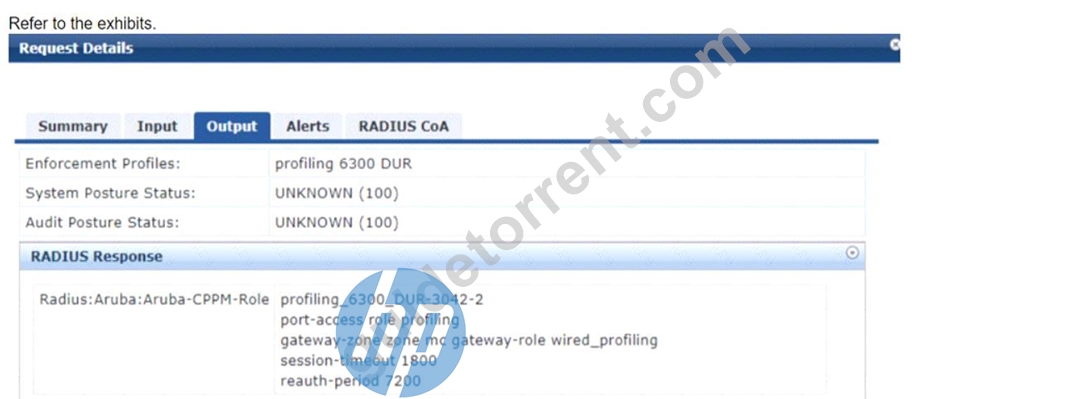
What is one thing can you determine from the exhibits?
- A. CPPM originally assigned the client to a role for non-profiled devices. It sent a CoA to the authenticator after it categorized the device.
- B. CPPM sent a CoA message to the client to prompt the client to submit information that CPPM can use to profile it.
- C. CPPM was never able to determine a device category for this device, so you need to check settings in the network infrastructure to ensure they support CPPM's endpoint classification.
- D. CPPM first assigned the client to a role based on the user's identity. Then, it discovered that the client had an invalid category, so it sent a CoA to blacklist the client.
Answer: A
Explanation:
Based on the exhibits which seem to show RADIUS authentication and CoA logs, one can determine that CPPM (ClearPass Policy Manager) initially assigned the client to a role meant for non-profiled devices and then sent a CoA to the network access device (authenticator) once the device was categorized. This is a common workflow in network access control, where a device is first given limited access until it can be properly identified, after which appropriate access policies are applied.
NEW QUESTION # 38
What is one way that Control Plane Security (CPsec) enhances security for me network?
- A. It prevents access from unauthorized IP addresses to critical services, such as SSH on Mobility Controllers (MCs).
- B. It prevents Denial of Service (DoS) attacks against Mobility Controllers' (MCs") control plane.
- C. It protects wireless clients' traffic tunneled between APs and Mobility Controllers, from eavesdropping
- D. It protects management traffic between APs and Mobility Controllers (MCs) from eavesdropping.
Answer: C
NEW QUESTION # 39
What role does the Aruba ClearPass Device Insight Analyzer play in the Device Insight architecture?
- A. It resides in the cloud and manages licensing and configuration for Collectors
- B. It resides on-prem and provides the span port to which traffic is mirrored for deep analytics.
- C. It resides In the cloud and applies machine learning and supervised crowdsourcing to metadata sent by Collectors
- D. It resides on-prem and is responsible for running active SNMP and Nmap scans
Answer: C
Explanation:
The Aruba ClearPass Device Insight Analyzer plays a crucial role within the Device Insight architecture by residing in the cloud and applying machine learning and supervised crowdsourcing to the metadata sent by Collectors. This component of the architecture is responsible for analyzing vast amounts of data collected from the network to identify and classify devices accurately. By utilizing machine learning algorithms and crowdsourced input, the Device Insight Analyzer enhances the accuracy of device detection and classification, thereby improving the overall security and management of the network.
References:
Aruba ClearPass official documentation and whitepapers that detail the functionality and deployment of the Device Insight Analyzer.
Technical articles and presentations on network security solutions that discuss the use of machine learning and data analytics in device management.
NEW QUESTION # 40
Which correctly describes a way to deploy certificates to end-user devices?
- A. ClearPass Onboard can help to deploy certificates to end-user devices, whether or not they are members of a Windows domain
- B. ClearPass OnGuard can help to deploy certificates to end-user devices, whether or not they are members of a Windows domain
- C. in a Windows domain, domain group policy objects (GPOs) can automatically install computer, but not user certificates
- D. ClearPass Device Insight can automatically discover end-user devices and deploy the proper certificates to them
Answer: A
NEW QUESTION # 41
What is a guideline for deploying Aruba ClearPass Device Insight?
- A. Configure remote mirroring on access layer Aruba switches, using Device Insight Analyzer as the destination IP.
- B. For companies with multiple sites, deploy a pair of Device Insight Collectors at the HQ or the central data center.
- C. Make sure that Aruba devices trust the root CA certificate for the ClearPass Device Insight Analyzer's HTTPS certificate.
- D. Deploy a Device Insight Collector at every site in the corporate WAN to reduce the impact on WAN links.
Answer: B
Explanation:
For deploying Aruba ClearPass Device Insight effectively, especially in environments with multiple sites, it is recommended to deploy a pair of Device Insight Collectors at the headquarters or the central data center.
This deployment strategy helps in centralizing the data collection and analysis, which simplifies management and enhances performance by reducing the data load on the WAN links connecting different sites.
Centralizing the collectors at a major site or data center allows for better scalability and reliability of the network management system. This configuration also aids in achieving a more consistent and comprehensive monitoring and analysis of the devices across the network, ensuring that the security and management policies are uniformly applied. This recommendation is based on best practices for network architecture design, particularly those discussed in Aruba's deployment guides and network management strategies.
NEW QUESTION # 42
An ArubaOS-CX switch enforces 802.1X on a port. No fan-through options or port-access roles are configured on the port The 802 1X supplicant on a connected client has not yet completed authentication Which type of traffic does the authenticator accept from the client?
- A. EAP only
- B. DHCP, DNS, and EAP only
- C. RADIUS only
- D. DHCP, DNS and RADIUS only
Answer: A
NEW QUESTION # 43
What is a reason to set up a packet capture on an Aruba Mobility Controller (MC)?
- A. You want the MC to analyze wireless clients' traffic at a lower level, so that the ArubaOS firewall can control the traffic I based on application.
- B. The company wants to use ClearPass Policy Manager (CPPM) to profile devices and needs to receive HTTP User-Agent strings from the MC.
- C. You want the MC to analyze wireless clients' traffic at a lower level, so that the ArubaOS firewall can control Web traffic based on the destination URL.
- D. The security team believes that a wireless endpoint connected to the MC is launching an attack and wants to examine the traffic more closely.
Answer: D
Explanation:
Setting up a packet capture on an Aruba Mobility Controller (MC) is particularly useful in scenarios where detailed analysis of network traffic is necessary to identify and address security concerns. Option B is the correct answer because it directly addresses the need to closely examine the traffic of a potentially malicious wireless endpoint. Packet capture on the MC allows the security team to collect and analyze traffic to/from specific endpoints in real-time, providing valuable insights into the nature of the traffic and potentially identifying harmful activities. This capability is essential for forensics and troubleshooting security incidents, enabling administrators to respond effectively to threats.
References:
Aruba Mobility Controller Configuration Guide
Aruba Networks Official Documentation
NEW QUESTION # 44
What is a benefit of deploying Aruba ClearPass Device insight?
- A. Highly accurate endpoint classification for environments with many devices types, including Internet of Things (loT)
- B. Agent-based analysts of devices' security settings and health status, with the ability to implement quarantining
- C. Simpler troubleshooting of ClearPass solutions across an environment with multiple ClearPass Policy Managers
- D. visibility into devices' 802.1X supplicant settings and automated certificate deployment
Answer: A
Explanation:
Aruba ClearPass Device Insight offers a significant benefit by providing highly accurate endpoint classification. This feature is particularly useful in complex environments with a wide variety of device types, including IoT devices. Accurate device classification allows network administrators to better understand the nature and behavior of devices on their network, which is crucial for implementing appropriate security policies and ensuring network performance and security.
NEW QUESTION # 45
You are deploying an Aruba Mobility Controller (MC). What is a best practice for setting up secure management access to the ArubaOS Web UP
- A. Avoid using external manager authentication tor the Web UI.
- B. Change the default 4343 port tor the web UI to TCP 443.
- C. Make sure to enable HTTPS for the Web UI and select the self-signed certificate Installed in the factory.
- D. Install a CA-signed certificate to use for the Web UI server certificate.
Answer: D
Explanation:
For securing management access to the ArubaOS Web UI of an Aruba Mobility Controller (MC), it is a best practice to install a certificate signed by a Certificate Authority (CA). This ensures that communications between administrators and the MC are secured with trusted encryption, which greatly reduces the risk of man-in-the-middle attacks. Using a CA-signed certificate enhances the trustworthiness of the connection over self-signed certificates, which do not offer the same level of assurance.References:
ArubaOS documentation on management access security.
NEW QUESTION # 46
What is a correct guideline for the management protocols that you should use on ArubaOS-Switches?
- A. Disable Telnet and use SSH instead
- B. Disable SSH and use https instead.
- C. Disable Telnet and use TFTP instead.
- D. Disable HTTPS and use SSH instead
Answer: A
Explanation:
In managing ArubaOS-Switches, the best practice is to disable less secure protocols such as Telnet and use more secure alternatives like SSH (Secure Shell). SSH provides encrypted connections between network devices, which is critical for maintaining the security and integrity of network communications. This guideline is aligned with general security best practices that prioritize the use of protocols with strong, built-in encryption mechanisms to prevent unauthorized access and ensure data privacy.
NEW QUESTION # 47
You configure an ArubaOS-Switch to enforce 802.1X authentication with ClearPass Policy Manager (CPPM) denned as the RADIUS server Clients cannot authenticate You check Aruba ClearPass Access Tracker and cannot find a record of the authentication attempt.
What are two possible problems that have this symptom? (Select two)
- A. Clients are configured to use a mismatched EAP method from the one In the CPPM service.
- B. CPPM does not have a network device defined for the switch's IP address.
- C. Clients are not configured to trust the root CA certificate for CPPM's RADIUS/EAP certificate.
- D. users are logging in with the wrong usernames and passwords or invalid certificates.
- E. The RADIUS shared secret does not match between the switch and CPPM.
Answer: C,D
NEW QUESTION # 48 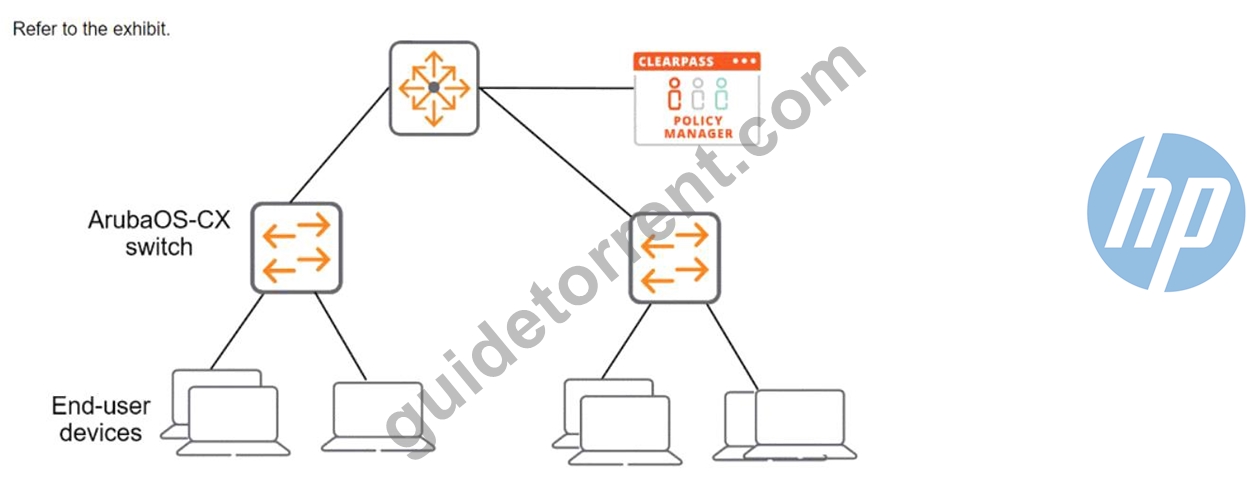
What is another setting that you must configure on the switch to meet these requirements?
- A. Configure a CPPM username and password that match a CPPM admin account.
- B. Disable SSH on the default VRF and enable it on the mgmt VRF instead.
- C. Create port-access roles with the same names of the roles that CPPM will send in Aruba-Admin-Role VSAs.
- D. Set the aaa authentication login method for SSH to the "radius" server-group (with local as backup).
Answer: D
Explanation:
To meet the requirements for configuring an ArubaOS-CX switch for integration with ClearPass Policy Manager (CPPM), it is necessary to set the AAA authentication login method for SSH to use the "radius" server-group, with "local" as a backup. This ensures that when an admin attempts to SSH into the switch, the authentication request is first sent to CPPM via RADIUS. If CPPM is unavailable, the switch will fall back to using local authentication12.
Here's why the other options are not correct:
Option B is incorrect because configuring a CPPM username and password on the switch that matches a CPPM admin account is not required for SSH login; rather, the switch needs to be configured to communicate with CPPM for authentication.
Option C is incorrect because while CPPM will send Aruba-Admin-Role Vendor-Specific Attributes (VSAs), the switch does not need to have port-access roles created with the same names; it needs to interpret the VSA to assign the correct role.
Option D is incorrect because disabling SSH on the default VRF and enabling it on the mgmt VRF is not related to the authentication process with CPPM.
Therefore, the correct answer is A, as setting the AAA authentication login method for SSH to the "radius" server-group with "local" as backup is a key step in ensuring that the switch can authenticate admins through CPPM while providing a fallback method12.
NEW QUESTION # 49 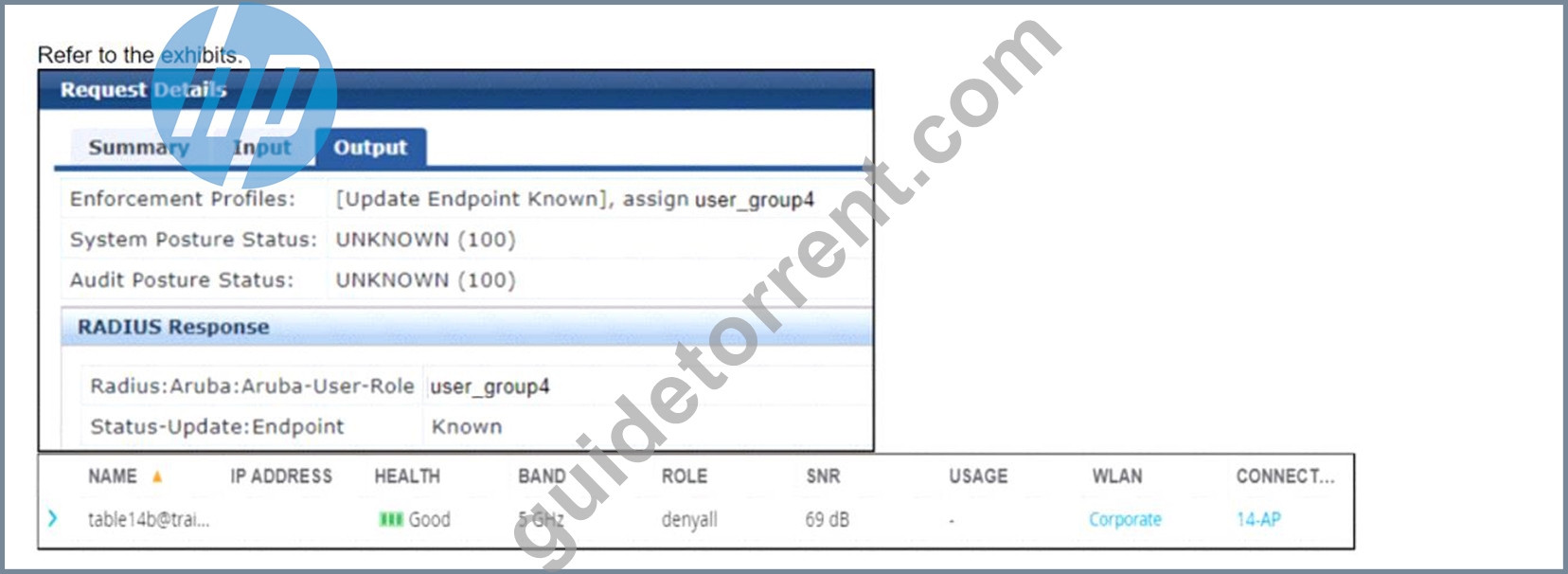
A company has added a new user group. Users in the group try to connect to the WLAN and receive errors that the connection has no Internet access. The users cannot reach any resources. The first exhibit shows the record for one of the users who cannot connect. The second exhibit shows the role to which the ArubaOS device assigned the user's client.
What is a likely problem?
- A. The clients rejected the server authentication on their side because they do not have the root CA for CPPM's RADIUS/EAP certificate.
- B. The ArubaOS device has a server derivation rule configured on it that has overridden the role sent by CPPM.
- C. The ArubaOS device does not have the correct RADIUS dictionaries installed on it to under-stand the Aruba-User-Role VSA.
- D. The role name that CPPM is sending does not match the role name configured on the Aru-baOS device.
Answer: D
Explanation:
The image indicates that there is an issue with the user role assignment, which is key to network access in ArubaOS. If the user role name sent by CPPM doesn't match any of the roles defined in the ArubaOS, then the user will be assigned a default or incorrect role that does not have the necessary permissions, thus leading to the connection errors and lack of Internet access. Ensuring that the role names are consistent between CPPM and ArubaOS can resolve this issue.
NEW QUESTION # 50
Refer to the exhibit.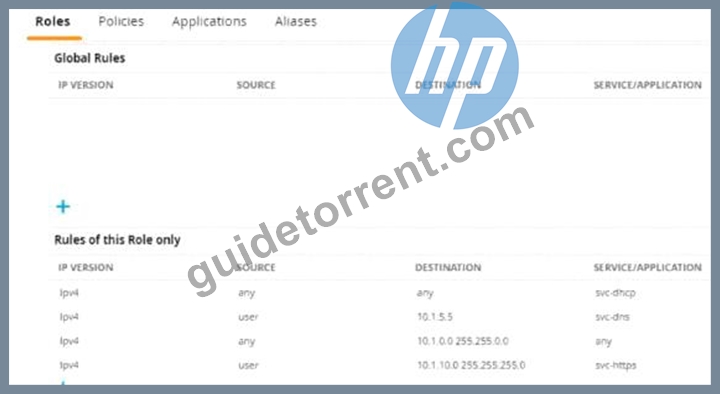
A diem is connected to an ArubaOS Mobility Controller. The exhibit snows all Tour firewall rules that apply to this diem What correctly describes how the controller treats HTTPS packets to these two IP addresses, both of which are on the other side of the firewall
10.1 10.10
203.0.13.5
- A. it permits both of the packets
- B. It permits the packet to 10.1.10.10 and drops the packet to 203 0.13.5
- C. It drops both of the packets
- D. It drops the packet to 10.1.10.10 and permits the packet to 203.0.13.5.
Answer: B
Explanation:
Referring to the exhibit, the ArubaOS Mobility Controller treats HTTPS packets based on the firewall rules applied to the client. The rule that allows svc-https service for destination IP range 10.1.0.0 255.255.0.0 would permit an HTTPS packet to 10.1.10.10 since this IP address falls within the specified range. There are no rules shown that would allow traffic to the IP address 203.0.13.5; hence, the packet to this address would be dropped.
References:
ArubaOS firewall configuration guides detailing how firewall rules are interpreted and applied to traffic.
Network security textbooks explaining firewall rule processing and packet filtering based on source and destination IP addresses.
NEW QUESTION # 51
What is one of the roles of the network access server (NAS) in the AAA framewonx?
- A. It authenticates legitimate users and uses policies to determine which resources each user is allowed to access.
- B. It enforces access to network services and sends accounting information to the AAA server
- C. It determines which resources authenticated users are allowed to access and monitors each users session
- D. It negotiates with each user's device to determine which EAP method is used for authentication
Answer: B
Explanation:
In the AAA (Authentication, Authorization, and Accounting) framework, the role of the Network Access Server (NAS) is to act as a gateway that enforces access to network services and sends accounting information to the AAA server. The NAS initially requests authentication information from the user and then passes that information to the AAA server. It also enforces the access policies as provided by the AAA server after authentication and provides accounting data to the AAA server based on user activity.
References:
Technical literature on AAA protocols which often includes a description of the roles and responsibilities of a Network Access Server.
Network security resources that discuss the NAS function within the AAA framework.
NEW QUESTION # 52
What is one way that WPA3-Enterprise enhances security when compared to WPA2-Enterprise?
- A. WPA3-Enterprise can operate in CNSA mode, which mandates that the 802.11 association uses secure algorithms.
- B. WPA3-Enterprise uses Diffie-Hellman in order to authenticate clients, while WPA2-Enterprise uses
802.1X authentication. - C. WPA3-Enterprise implements the more secure simultaneous authentication of equals (SAE), while WPA2-Enterprise uses 802.1X.
- D. WPA3-Enterprise provides built-in mechanisms that can deploy user certificates to authorized end-user devices.
Answer: A
Explanation:
WPA3-Enterprise enhances network security over WPA2-Enterprise through several improvements, one of which is the ability to operate in CNSA (Commercial National Security Algorithm) mode. This mode mandates the use of secure cryptographic algorithms during the 802.11 association process, ensuring that all communications are highly secure. The CNSA suite provides stronger encryption standards designed to protect sensitive government, military, and industrial communications. Unlike WPA2, WPA3's CNSA mode uses stronger cryptographic primitives, such as AES-256 in Galois/Counter Mode (GCM) for encryption and SHA-384 for hashing, which are not standard in WPA2-Enterprise.
NEW QUESTION # 53
......
HPE6-A78 Exam Questions and Valid PMP Dumps PDF: https://www.guidetorrent.com/HPE6-A78-pdf-free-download.html
HP HPE6-A78 Certification Real 2024 Mock Exam: https://drive.google.com/open?id=1eejrr-Srfq73-cFZW-zMqUashCMypJ9s