
Free HP HPE6-A78 Test Practice Test Questions Exam Dumps
Prepare Top HP HPE6-A78 Exam Audio Study Guide Practice Questions Edition
HPE6-A78 exam is designed for IT professionals who have experience in implementing network security solutions in enterprise environments. HPE6-A78 exam covers a wide range of topics, including network security fundamentals, wireless security, secure network access, and advanced firewall policies. Candidates who pass the HPE6-A78 exam will have demonstrated their ability to implement and configure Aruba's network security solutions effectively.
NEW QUESTION # 28
What is a guideline for deploying Aruba ClearPass Device Insight?
- A. Deploy a Device Insight Collector at every site in the corporate WAN to reduce the impact on WAN links.
- B. Make sure that Aruba devices trust the root CA certificate for the ClearPass Device Insight Analyzer's HTTPS certificate.
- C. For companies with multiple sites, deploy a pair of Device Insight Collectors at the HQ or the central data center.
- D. Configure remote mirroring on access layer Aruba switches, using Device Insight Analyzer as the destination IP.
Answer: C
Explanation:
For deploying Aruba ClearPass Device Insight effectively, especially in environments with multiple sites, it is recommended to deploy a pair of Device Insight Collectors at the headquarters or the central data center. This deployment strategy helps in centralizing the data collection and analysis, which simplifies management and enhances performance by reducing the data load on the WAN links connecting different sites. Centralizing the collectors at a major site or data center allows for better scalability and reliability of the network management system. This configuration also aids in achieving a more consistent and comprehensive monitoring and analysis of the devices across the network, ensuring that the security and management policies are uniformly applied. This recommendation is based on best practices for network architecture design, particularly those discussed in Aruba's deployment guides and network management strategies.
NEW QUESTION # 29
A company has an Aruba solution with a Mobility Master (MM) Mobility Controllers (MCs) and campus Aps. What is one benefit of adding Aruba Airwave from the perspective of forensics?
- A. Airwave is required to activate Wireless Intrusion Prevention (WIP) services on the ArubaOS solution
- B. Airwave retains information about the network for much longer periods than ArubaOS solution
- C. Airwave can provide more advanced authentication and access control services for the AmbaOS solution
- D. AirWave enables low level debugging on the devices across the ArubaOS solution
Answer: B
Explanation:
Adding Aruba Airwave to an Aruba solution that includes a Mobility Master (MM), Mobility Controllers (MCs), and campus APs offers several benefits, notably in the realm of network forensics. One of the significant advantages is that Airwave can retain detailed information about the network for much longer periods than what is typically possible with just ArubaOS solutions. This extensive data retention is crucial for forensic analysis, allowing network administrators and security professionals to conduct thorough investigations of past incidents. With access to historical data, professionals can identify trends, pinpoint security breaches, and understand the impact of specific changes or events within the network over time.
:
Aruba's official product documentation and user guides for Airwave and ArubaOS, which outline features, benefits, and use cases related to network management and forensic capabilities.
Industry case studies and whitepapers that discuss the implementation and advantages of integrating Airwave into existing network infrastructure for enhanced monitoring and security.
NEW QUESTION # 30
Refer to the exhibit:
port-access role role1 vlan access 11
port-access role role2 vlan access 12
port-access role role3 vlan access 13
port-access role role4 vlan access 14
aaa authentication port-access dot1x authenticator
enable
interface 1/1/1
no shutdown
no routing
vlan access 1
aaa authentication port-access critical-role role1
aaa authentication port-access preauth-role role2
aaa authentication port-access auth-role role3
interface 1/1/2
no shutdown
no routing
vlan access 1
aaa authentication port-access critical-role role1
aaa authentication port-access preauth-role role2
aaa authentication port-access auth-role role3
The exhibit shows the configuration on an AOS-CX switch.
Client1 connects to port 1/1/1 and authenticates to HPE Aruba Networking ClearPass Policy Manager (CPPM). CPPM sends an Access-Accept with this VSA: Aruba-User-Role: role4.
Client2 connects to port 1/1/2 and does not attempt to authenticate.
To which roles are the users assigned?
- A. Client1 = role4; Client2 = role1
- B. Client1 = role3; Client2 = role2
- C. Client1 = role3; Client2 = role1
- D. Client1 = role4; Client2 = role2
Answer: D
Explanation:
The scenario involves an AOS-CX switch configured for 802.1X port-access authentication. The configuration defines several roles and their associated VLANs:
port-access role role1 vlan access 11: Role1 assigns VLAN 11.
port-access role role2 vlan access 12: Role2 assigns VLAN 12.
port-access role role3 vlan access 13: Role3 assigns VLAN 13.
port-access role role4 vlan access 14: Role4 assigns VLAN 14.
The switch has 802.1X authentication enabled globally (aaa authentication port-access dot1x authenticator enable). Two ports are configured:
Interface 1/1/1:
vlan access 1: Default VLAN is 1.
aaa authentication port-access critical-role role1: If the RADIUS server is unavailable, assign role1 (VLAN 11).
aaa authentication port-access preauth-role role2: Before authentication, assign role2 (VLAN 12).
aaa authentication port-access auth-role role3: After successful authentication, assign role3 (VLAN 13) unless overridden by a VSA.
Interface 1/1/2: Same configuration as 1/1/1.
Client1 on port 1/1/1:
Client1 authenticates successfully, and CPPM sends an Access-Accept with the VSA Aruba-User-Role: role4.
In AOS-CX, the auth-role (role3) is applied after successful authentication unless the RADIUS server specifies a different role via the Aruba-User-Role VSA. Since CPPM sends Aruba-User-Role: role4, and role4 exists on the switch, Client1 is assigned role4 (VLAN 14), overriding the default auth-role (role3).
Client2 on port 1/1/2:
Client2 does not attempt to authenticate (i.e., does not send 802.1X credentials).
In AOS-CX, if a client does not attempt authentication and no other authentication method (e.g., MAC authentication) is configured, the client is placed in the preauth-role (role2, VLAN 12). This role is applied before authentication or when authentication is not attempted, allowing the client limited access (e.g., to perform authentication or access a captive portal).
Option A, "Client1 = role3; Client2 = role2," is incorrect because Client1 should be assigned role4 (from the VSA), not role3.
Option B, "Client1 = role4; Client2 = role1," is incorrect because Client2 should be assigned the preauth-role (role2), not the critical-role (role1), since the RADIUS server is reachable (Client1 authenticated successfully).
Option C, "Client1 = role4; Client2 = role2," is correct. Client1 gets role4 from the VSA, and Client2 gets the preauth-role (role2) since it does not attempt authentication.
Option D, "Client1 = role3; Client2 = role1," is incorrect for the same reasons as Option A and Option B.
The HPE Aruba Networking AOS-CX 10.12 Security Guide states:
"After successful 802.1X authentication, the AOS-CX switch assigns the client to the auth-role configured for the port (e.g., aaa authentication port-access auth-role role3). However, if the RADIUS server returns an Aruba-User-Role VSA (e.g., Aruba-User-Role: role4), and the specified role exists on the switch, the client is assigned that role instead of the auth-role. If a client does not attempt authentication and no other authentication method is configured, the client is assigned the preauth-role (e.g., aaa authentication port-access preauth-role role2), which provides limited access before authentication." (Page 132, 802.1X Authentication Section) Additionally, the guide notes:
"The critical-role (e.g., aaa authentication port-access critical-role role1) is applied only when the RADIUS server is unavailable. The preauth-role is applied when a client connects but does not attempt 802.1X authentication." (Page 134, Port-Access Roles Section)
:
HPE Aruba Networking AOS-CX 10.12 Security Guide, 802.1X Authentication Section, Page 132.
HPE Aruba Networking AOS-CX 10.12 Security Guide, Port-Access Roles Section, Page 134.
NEW QUESTION # 31
What is one benefit of enabling Enhanced Secure mode on an ArubaOS-Switch?
- A. All interfaces have 802.1X authentication enabled on them by default.
- B. Control Plane policing rate limits edge ports to mitigate DoS attacks on network servers.
- C. A self-signed certificate is automatically added to the switch trusted platform module (TPM).
- D. Insecure algorithms for protocol such as SSH are automatically disabled.
Answer: D
Explanation:
In the context of ArubaOS-Switches, enabling Enhanced Secure mode has several benefits, one of which includes disabling insecure algorithms for protocols such as SSH. This is in line with security best practices, as older, less secure algorithms are known to be vulnerable to various types of cryptographic attacks. When Enhanced Secure mode is enabled, the switch automatically restricts the use of such algorithms, thereby enhancing the security of management access.
NEW QUESTION # 32
You configure an ArubaOS-Switch to enforce 802.1X authentication with ClearPass Policy Manager (CPPM) denned as the RADIUS server Clients cannot authenticate You check Aruba ClearPass Access Tracker and cannot find a record of the authentication attempt.
What are two possible problems that have this symptom? (Select two)
- A. Clients are not configured to trust the root CA certificate for CPPM's RADIUS/EAP certificate.
- B. CPPM does not have a network device defined for the switch's IP address.
- C. Clients are configured to use a mismatched EAP method from the one In the CPPM service.
- D. The RADIUS shared secret does not match between the switch and CPPM.
- E. users are logging in with the wrong usernames and passwords or invalid certificates.
Answer: A,E
NEW QUESTION # 33
What is one thing can you determine from the exhibits?
- A. CPPM originally assigned the client to a role for non-profiled devices. It sent a CoA to the authenticator after it categorized the device.
- B. CPPM first assigned the client to a role based on the user's identity. Then, it discovered that the client had an invalid category, so it sent a CoA to blacklist the client.
- C. CPPM sent a CoA message to the client to prompt the client to submit information that CPPM can use to profile it.
- D. CPPM was never able to determine a device category for this device, so you need to check settings in the network infrastructure to ensure they support CPPM's endpoint classification.
Answer: A
Explanation:
Based on the exhibits which seem to show RADIUS authentication and CoA logs, one can determine that CPPM (ClearPass Policy Manager) initially assigned the client to a role meant for non-profiled devices and then sent a CoA to the network access device (authenticator) once the device was categorized. This is a common workflow in network access control, where a device is first given limited access until it can be properly identified, after which appropriate access policies are applied.
NEW QUESTION # 34
An AOS-CX switch currently has no device fingerprinting settings configured on it. You want the switch to start collecting DHCP and LLDP information. You enter these commands:
Switch(config)# client device-fingerprint profile myprofile
Switch(myprofile)# dhcp
Switch(myprofile)# lldp
What else must you do to allow the switch to collect information from clients?
- A. Add at least one LLDP option to the policy
- B. Add at least one DHCP option to the policy
- C. Apply the policy to edge ports
- D. Configure the switch as a DHCP relay
Answer: C
Explanation:
Device fingerprinting on an AOS-CX switch allows the switch to collect information about connected clients to aid in profiling and policy enforcement, often in conjunction with a solution like ClearPass Policy Manager (CPPM). The commands provided create a device fingerprinting profile named "myprofile" and enable the collection of DHCP and LLDP information:
client device-fingerprint profile myprofile: Creates a fingerprinting profile.
dhcp: Enables the collection of DHCP information (e.g., DHCP options like Option 55 for fingerprinting).
lldp: Enables the collection of LLDP (Link Layer Discovery Protocol) information (e.g., system name, description).
However, creating the profile and enabling DHCP and LLDP collection is not enough for the switch to start collecting this information from clients. The profile must be applied to the interfaces (ports) where clients are connected.
Option C, "Apply the policy to edge ports," is correct. In AOS-CX, the device fingerprinting profile must be applied to the edge ports (ports where clients connect) to enable the switch to collect DHCP and LLDP information from those clients. This is done using the command client device-fingerprint profile <profile-name> under the interface configuration. For example, on port 1/1/1, you would enter:
text
CollapseWrapCopy
Switch(config)# interface 1/1/1
Switch(config-if)# client device-fingerprint profile myprofile
This ensures that the switch collects DHCP and LLDP data from clients connected to the specified ports.
Option A, "Configure the switch as a DHCP relay," is incorrect. While a DHCP relay (using the ip helper-address command) is needed if the DHCP server is on a different subnet, it is not a requirement for the switch to collect DHCP information for fingerprinting. The switch can snoop DHCP traffic on the local VLAN without being a relay, as long as the profile is applied to the ports.
Option B, "Add at least one LLDP option to the policy," is incorrect. The lldp command in the fingerprinting profile already enables the collection of LLDP information. There is no need to specify individual LLDP options (e.g., system name, description) in the profile; the switch collects all available LLDP data by default.
Option D, "Add at least one DHCP option to the policy," is incorrect. The dhcp command in the fingerprinting profile already enables the collection of DHCP information, including options like Option 55 (Parameter Request List), which is commonly used for fingerprinting. There is no need to specify individual DHCP options in the profile.
The HPE Aruba Networking AOS-CX 10.12 Security Guide states:
"To enable device fingerprinting on an AOS-CX switch, create a device fingerprinting profile using the client device-fingerprint profile <name> command, and specify the protocols to collect, such as dhcp for DHCP information and lldp for LLDP information. To start collecting data from clients, apply the profile to edge ports where clients connect using the command client device-fingerprint profile <name> under the interface configuration. For example, interface 1/1/1 followed by client device-fingerprint profile myprofile enables fingerprinting on port 1/1/1." (Page 160, Device Fingerprinting Configuration Section) Additionally, the HPE Aruba Networking AOS-CX 10.12 System Management Guide notes:
"The device fingerprinting profile must be applied to the ports where clients are connected to collect DHCP and LLDP information. The dhcp and lldp commands in the profile enable the collection of all relevant data for those protocols, such as DHCP Option 55 for fingerprinting, without requiring additional options to be specified." (Page 95, Device Fingerprinting Setup Section)
:
HPE Aruba Networking AOS-CX 10.12 Security Guide, Device Fingerprinting Configuration Section, Page 160.
HPE Aruba Networking AOS-CX 10.12 System Management Guide, Device Fingerprinting Setup Section, Page 95.
NEW QUESTION # 35
Refer to the exhibit.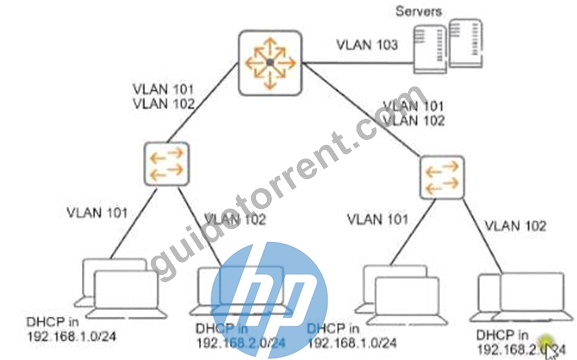
You need to ensure that only management stations in subnet 192.168.1.0/24 can access the ArubaOS-Switches' CLI. Web Ul. and REST interfaces The company also wants to let managers use these stations to access other parts of the network What should you do?
- A. Configure the switch to listen for these protocols on OOBM only.
- B. Establish a Control Plane Policing class that selects traffic from 192.168 1.0/24.
- C. Specify vlan 100 as the management vlan for the switches.
- D. Specify 192.168.1.0.255.255.255.0 as authorized IP manager address
Answer: D
Explanation:
To ensure that only management stations in the subnet 192.168.1.0/24 can access the ArubaOS-Switches' Command Line Interface (CLI), Web UI, and REST interfaces, while also allowing managers to access other parts of the network, you should specify 192.168.1.0 255.255.255.0 as the authorized manager IP address on the switches. This configuration will restrict access to the switch management interfaces to devices within the specified IP address range, effectively creating a management access list.
References:
ArubaOS-Switch management and configuration guide detailing IP authorized manager settings.
Network management best practices which recommend controlling access to network devices' management interfaces.
NEW QUESTION # 36
What is a Key feature of me ArubaOS firewall?
- A. The firewall is stateful which means that n can track client sessions and automatically allow return traffic for permitted sessions
- B. The firewall examines all traffic at Layer 2 through Layer 4 and uses source IP addresses as the primary way to determine how to control traffic.
- C. The firewall is designed to fitter traffic primarily based on wireless 802.11 headers, making it ideal for mobility environments
- D. The firewall Includes application layer gateways (ALGs). which it uses to filter Web traffic based on the reputation of the destination web site.
Answer: D
NEW QUESTION # 37
Refer to the exhibit.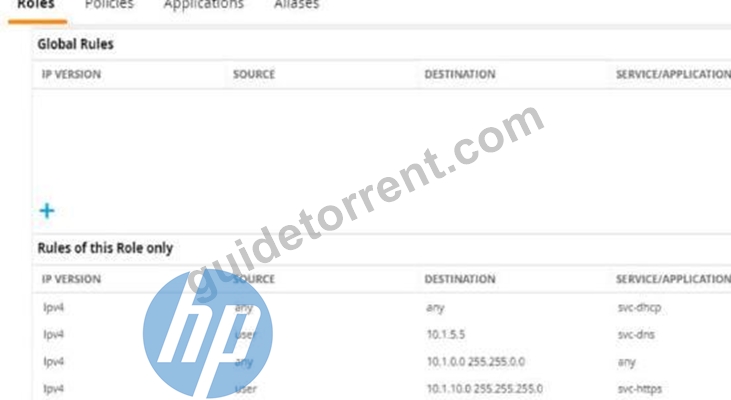
A diem is connected to an ArubaOS Mobility Controller. The exhibit snows all Tour firewall rules that apply to this diem What correctly describes how the controller treats HTTPS packets to these two IP addresses, both of which are on the other side of the firewall
10.1 10.10
203.0.13.5
- A. It drops the packet to 10.1.10.10 and permits the packet to 203.0.13.5.
- B. It permits the packet to 10.1.10.10 and drops the packet to 203 0.13.5
- C. it permits both of the packets
- D. It drops both of the packets
Answer: C
NEW QUESTION # 38
A company is deploying ArubaOS-CX switches to support 135 employees, which will tunnel client traffic to an Aruba Mobility Controller (MC) for the MC to apply firewall policies and deep packet inspection (DPI). This MC will be dedicated to receiving traffic from the ArubaOS-CX switches.
What are the licensing requirements for the MC?
- A. one AP license per-switch. and one PEF license per-switch
- B. one PEF license per-switch. and one WCC license per-switch
- C. one PEF license per-switch
- D. one AP license per-switch
Answer: C
Explanation:
When deploying ArubaOS-CX switches that tunnel client traffic to an Aruba Mobility Controller (MC), the licensing requirements typically involve Policy Enforcement Firewall (PEF) licenses. These licenses enable the MC to enforce firewall policies and perform deep packet inspection (DPI). Therefore, for each switch tunneling traffic to the MC, a PEF license would be necessary.
NEW QUESTION # 39
Refer to the exhibit, which shows the settings on the company's MCs.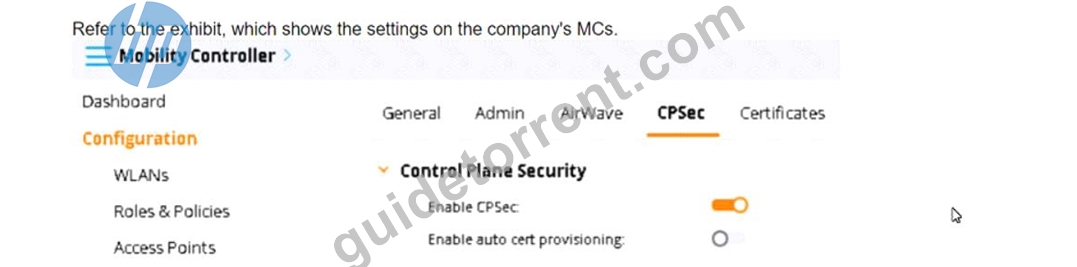
- Mobility Controller
Dashboard General Admin AirWave CPSec Certificates
Configuration
WLANsv Control Plane Security
Roles & PoliciesEnable CP Sec
Access PointsEnable auto cert provisioning:
You have deployed about 100 new Aruba 335-APs. What is required for the APs to become managed?
- A. configuring a PAPI key that matches on the APs and MCs
- B. installing CA-signed certificates on the APs
- C. installing self-signed certificates on the APs
- D. approving the APs as authorized APs on the AP whitelist
Answer: D
Explanation:
Based on the exhibit, which shows the settings on the company's Mobility Controllers (MCs), with 'Control Plane Security' enabled and 'Enable auto cert provisioning' available, new Aruba 335-APs require approval on the MC to become managed. This is commonly done by adding the APs to an authorized AP whitelist, after which they can be automatically provisioned with certificates generated by the MC.
NEW QUESTION # 40
A company is deploying ArubaOS-CX switches to support 135 employees, which will tunnel client traffic to an Aruba Mobility Controller (MC) for the MC to apply firewall policies and deep packet inspection (DPI).
This MC will be dedicated to receiving traffic from the ArubaOS-CX switches.
What are the licensing requirements for the MC?
- A. one AP license per-switch. and one PEF license per-switch
- B. one PEF license per-switch
- C. one PEF license per-switch. and one WCC license per-switch
- D. one AP license per-switch
Answer: A
NEW QUESTION # 41
What is an example or phishing?
- A. An attacker checks a user's password by using trying millions of potential passwords.
- B. An attacker lures clients to connect to a software-based AP that is using a legitimate SSID.
- C. An attacker sends emails posing as a service team member to get users to disclose their passwords.
- D. An attacker sends TCP messages to many different ports to discover which ports are open.
Answer: C
NEW QUESTION # 42
What is an Authorized client as defined by ArubaOS Wireless Intrusion Prevention System (WIP)?
- A. a client that has a certificate issued by a trusted Certification Authority (CA)
- B. a client that has successfully authenticated to an authorized AP and passed encrypted traffic
- C. a client that is not on the WIP blacklist
- D. a client that is on the WIP whitelist.
Answer: B
NEW QUESTION # 43
How can hackers implement a man-in-the-middle (MITM) attack against a wireless client?
- A. The hacker uses a combination of software and hardware to jam the RF band and prevent the client from connecting to any wireless networks.
- B. The hacker connects a device to the same wireless network as the client and responds to the client's ARP requests with the hacker device's MAC address.
- C. The hacker uses spear-phishing to probe for the IP addresses that the client is attempting to reach. The hacker device then spoofs those IP addresses.
- D. The hacker runs an NMap scan on the wireless client to find its MAC and IP address. The hacker then connects to another network and spoofs those addresses.
Answer: B
Explanation:
A common method for hackers to perform a man-in-the-middle (MITM) attack on a wireless network is by ARP poisoning. The attacker connects to the same network as the victim and sends false ARP messages over the network. This causes the victim's device to send traffic to the attacker's machine instead of the legitimate destination, allowing the attacker to intercept the traffic.
NEW QUESTION # 44
You are checking the Security Dashboard in the Web Ul for your ArubaOS solution and see that Wireless Intrusion Prevention (WIP) has discovered a rogue radio operating in ad hoc mode with open security. What correctly describes a threat that the radio could pose?
- A. It could open a backdoor into the corporate LAN for unauthorized users.
- B. It is running in a non-standard 802.11 mode and could effectively jam the wireless signal.
- C. It could be attempting to conceal itself from detection by changing its BSSID and SSID frequently.
- D. It is flooding the air with many wireless frames in a likely attempt at a DoS attack.
Answer: A
Explanation:
A rogue radio operating in ad hoc mode with open security can pose several threats to a network. Ad hoc networks allow direct device-to-device communication without centralized control. If such a radio is present within or near a corporate environment, it can potentially be used to create a peer-to-peer network that bypasses corporate security controls, effectively acting as a backdoor into the corporate network for unauthorized users or devices. This can lead to a breach of data security and unauthorized access to network resources.
NEW QUESTION # 45
......
Go to HPE6-A78 Questions - Try HPE6-A78 dumps pdf: https://www.guidetorrent.com/HPE6-A78-pdf-free-download.html
Dumps Practice Exam Questions Study Guide for the HPE6-A78 Exam: https://drive.google.com/open?id=12LiC3CNoSS-TT71iXa8FAAya0EV257a_