
CSSLP Free Study Guide! with New Update 349 Exam Questions
Get up-to-date Real Exam Questions for CSSLP UPDATED [2023]
NEW QUESTION # 140
Which of the following acts is used to recognize the importance of information security to the economic and national security interests of the United States?
- A. Computer Misuse Act
- B. Computer Fraud and Abuse Act
- C. Lanham Act
- D. FISMA
Answer: D
Explanation:
The Federal Information Security Management Act of 2002 is a United States federal law enacted in 2002 as Title III of the E-Government Act of 2002. The act recognized the importance of information security to the economic and national security interests of the United States. The act requires each federal agency to develop, document, and implement an agency-wide program to provide information security for the information and information systems that support the operations and assets of the agency, including those provided or managed by another agency, contractor, or other source. FISMA has brought attention within the federal government to cybersecurity and explicitly emphasized a 'risk-based policy for cost-effective security'. FISMA requires agency program officials, chief information officers, and Inspectors Generals (IGs) to conduct annual reviews of the agency's information security program and report the results to Office of Management and Budget (OMB). OMB uses this data to assist in its oversight responsibilities and to prepare this annual report to Congress on agency compliance with the act. Answer B is incorrect. The Lanham Act is a piece of legislation that contains the federal statutes of trademark law in the United States. The Act prohibits a number of activities, including trademark infringement, trademark dilution, and false advertising. It is also called Lanham Trademark Act. Answer A is incorrect. The Computer Misuse Act 1990 is an act of the UK Parliament which states the following statement: Unauthorized access to the computer material is punishable by 6 months imprisonment or a fine "not exceeding level 5 on the standard scale" (currently 5000). Unauthorized access with the intent to commit or facilitate commission of further offences is punishable by 6 months/maximum fine on summary conviction or 5 years/fine on indictment. Unauthorized modification of computer material is subject to the same sentences as section 2 offences. Answer C is incorrect. The Computer Fraud and Abuse Act is a law passed by the United States Congress in 1984 intended to reduce cracking of computer systems and to address federal computer-related offenses. The Computer Fraud and Abuse Act (codified as 18 U.S.C. 1030) governs cases with a compelling federal interest, where computers of the federal government or certain financial institutions are involved, where the crime itself is interstate in nature, or computers used in interstate and foreign commerce. It was amended in 1986, 1994, 1996, in 2001 by the USA PATRIOT Act, and in 2008 by the Identity Theft Enforcement and Restitution Act. Section (b) of the act punishes anyone who not just commits or attempts to commit an offense under the Computer Fraud and Abuse Act but also those who conspire to do so.
NEW QUESTION # 141
Which of the following intrusion detection systems (IDS) monitors network traffic and compares it against an established baseline?
- A. Explanation:
The anomaly-based intrusion detection system (IDS) monitors network traffic and compares it against an established baseline. This type of IDS monitors traffic and system activity for unusual behavior based on statistics. In order to identify a malicious activity, it learns normal behavior from the baseline. The anomaly-based intrusion detection is also known as behavior-based or statistical-based intrusion detection. - B. File-based
- C. Network-based
- D. Anomaly-based
- E. Signature-based
Answer: D
Explanation:
is incorrect. Signature-based IDS uses a database with signatures to identify possible attacks and malicious activity. Answer B is incorrect. A network-based IDS can be a dedicated hardware appliance, or an application running on a computer, attached to the network. It monitors all traffic in a network or traffic coming through an entry-point such as an Internet connection. Answer A is incorrect. There is no such intrusion detection system (IDS) that is file-based.
NEW QUESTION # 142
Which of the following processes culminates in an agreement between key players that a system in its current configuration and operation provides adequate protection controls?
- A. Information systems security engineering (ISSE)
- B. Risk Management
- C. Certification and accreditation (C&A)
- D. Information Assurance (IA)
Answer: C
Explanation:
Explanation/Reference:
Explanation: Certification and accreditation (C&A) is a set of processes that culminate in an agreement between key players that a system in its current configuration and operation provides adequate protection controls. Certification and Accreditation (C&A or CnA) is a process for implementing information security. It is a systematic procedure for evaluating, describing, testing, and authorizing systems prior to or after a system is in operation. The C&A process is used extensively in the U.S. Federal Government. Some C&A processes include FISMA, NIACAP, DIACAP, and DCID 6/3. Certification is a comprehensive assessment of the management, operational, and technical security controls in an information system, made in support of security accreditation, to determine the extent to which the controls are implemented correctly, operating as intended, and producing the desired outcome with respect to meeting the security requirements for the system. Accreditation is the official management decision given by a senior agency official to authorize operation of an information system and to explicitly accept the risk to agency operations (including mission, functions, image, or reputation), agency assets, or individuals, based on the implementation of an agreed- upon set of security controls. Answer: D is incorrect. Risk management is a set of processes that ensures a risk-based approach is used to determine adequate, cost- effective security for a system. Answer: A is incorrect. Information assurance (IA) is the process of organizing and monitoring information-related risks.
It ensures that only the approved users have access to the approved information at the approved time. IA practitioners seek to protect and defend information and information systems by ensuring confidentiality, integrity, authentication, availability, and non-repudiation. These objectives are applicable whether the information is in storage, processing, or transit, and whether threatened by an attack. Answer: B is incorrect. ISSE is a set of processes and solutions used during all phases of a system's life cycle to meet the system's information protection needs.
NEW QUESTION # 143
Which of the following documents is defined as a source document, which is most useful for the ISSE when classifying the needed security functionality?
- A. System Security Context
- B. IMM
- C. CONOPS
- D. Information Protection Policy (IPP)
Answer: D
Explanation:
Explanation/Reference:
Explanation: The Information Protection Policy (IPP) is defined as a source document, which is most useful for the ISSE when classifying the needed security functionality. The IPP document consists of the threats to the information management and the security services and controls needed to respond to those threats.
AnswerB is incorrect. The IMM is the source document describing the customer's needs based on
identifying users, processes, and information. AnswerC is incorrect. The System Security Context is the output of SE and ISSEP. It is the translation of the requirements into system parameters and possible measurement concepts that meet the defined requirements. Answer D is incorrect. The Concept of Operations (CONOPS) is a document describing the characteristics of a proposed system from the viewpoint of an individual who will use that system. It is used to communicate the quantitative and qualitative system characteristics to all stakeholders. CONOPS are widely used in the military or in government services, as well as other fields. A CONOPS generally evolves from a concept and is a description of how a set of capabilities may be employed to achieve desired objectives or a particular end state for a specific scenario.
NEW QUESTION # 144
You have a storage media with some data and you make efforts to remove this data. After performing this, you analyze that the data remains present on the media. Which of the following refers to the above mentioned condition?
- A. Object reuse
- B. Residual
- C. Data remanence
- D. Degaussing
Answer: C
Explanation:
Data remanence refers to the data that remains even after the efforts have been made for removing or erasing the data. This event occurs because of data being left intact by an insignificant file deletion operation, by storage media reformatting, or through physical properties of the storage medium. Data remanence can make unintentional disclosure of sensitive information possible. So, it is required that the storage media is released into an uncontrolled environment. Answer C and B are incorrect. These are the made-up disasters. Answer A is incorrect. Object reuse refers to reassigning some other object of a storage media that has one or more objects.
NEW QUESTION # 145
You and your project team have identified the project risks and now are analyzing the probability and impact of the risks. What type of analysis of the risks provides a quick and high-level review of each identified risk event?
- A. Quantitative risk analysis
- B. A risk probability-impact matrix
- C. Qualitative risk analysis
- D. Seven risk responses
Answer: C
Explanation:
Explanation/Reference:
Explanation: Qualitative risk analysis is a high-level, fast review of the risk event. Qualitative risk analysis qualifies the risk events for additional analysis.
NEW QUESTION # 146
Which of the following strategies is used to minimize the effects of a disruptive event on a company, and is created to prevent interruptions to normal business activity?
- A. Continuity of Operations Plan
- B. Contingency Plan
- C. Business Continuity Plan
- D. Explanation:
BCP is a strategy to minimize the consequence of the instability and to allow for the continuation of business processes. The goal of BCP is to minimize the effects of a disruptive event on a company, and is formed to avoid interruptions to normal business activity. Business Continuity Planning (BCP) is the creation and validation of a practiced logistical plan for how an organization will recover and restore partially or completely interrupted critical (urgent) functions within a predetermined time after a disaster or extended disruption. The logistical plan is called a business continuity plan. - E. Disaster Recovery Plan
Answer: C,D
Explanation:
is incorrect. A contingency plan is a plan devised for a specific situation when things could go wrong. Contingency plans are often devised by governments or businesses who want to be prepared for anything that could happen. Contingency plans include specific strategies and actions to deal with specific variances to assumptions resulting in a particular problem, emergency, or state of affairs. They also include a monitoring process and "triggers" for initiating planned actions. They are required to help governments, businesses, or individuals to recover from serious incidents in the minimum time with minimum cost and disruption. Answer C is incorrect. Disaster recovery planning is a subset of a larger process known as business continuity planning and should include planning for resumption of applications, data, hardware, communications (such as networking), and other IT infrastructure. A business continuity plan (BCP) includes planning for non-IT related aspects such as key personnel, facilities, crisis communication, and reputation protection, and should refer to the disaster recovery plan (DRP) for IT-related infrastructure recovery/continuity. Answer A is incorrect. The Continuity Of Operation Plan (COOP) refers to the preparations and institutions maintained by the United States government, providing survival of federal government operations in the case of catastrophic events. It provides procedures and capabilities to sustain an organization's essential. COOP is the procedure documented to ensure persistent critical operations throughout any period where normal operations are unattainable.
NEW QUESTION # 147
You and your project team have identified the project risks and now are analyzing the probability and impact of the risks. What type of analysis of the risks provides a quick and high-level review of each identified risk event?
- A. Quantitative risk analysis
- B. A risk probability-impact matrix
- C. Qualitative risk analysis
- D. Seven risk responses
Answer: C
Explanation:
Qualitative risk analysis is a high-level, fast review of the risk event. Qualitative risk analysis qualifies the risk events for additional analysis.
NEW QUESTION # 148
In which of the following types of tests are the disaster recovery checklists distributed to the members of disaster recovery team and asked to review the assigned checklist?
- A. Checklist test
- B. Simulation test
- C. Full-interruption test
- D. Parallel test
Answer: A
Explanation:
Explanation/Reference:
Explanation: A checklist test is a test in which the disaster recovery checklists are distributed to the members of the disaster recovery team. All members are asked to review the assigned checklist. The checklist test is a simple test and it is easy to conduct this test. It allows to accomplish the following three goals: It ensures that the employees are aware of their responsibilities and they have the refreshed knowledge. It provides an individual with an opportunity to review the checklists for obsolete information and update any items that require modification during the changes in the organization. It ensures that the assigned members of disaster recovery team are still working for the organization. Answer: B is incorrect.
A simulation test is a method used to test the disaster recovery plans. It operates just like a structured walk- through test. In the simulation test, the members of a disaster recovery team present with a disaster scenario and then, discuss on appropriate responses. These suggested responses are measured and some of them are taken by the team. The range of the simulation test should be defined carefully for avoiding excessive disruption of normal business activities. Answer: A is incorrect. A parallel test includes the next level in the testing procedure, and relocates the employees to an alternate recovery site and implements site activation procedures. These employees present with their disaster recovery responsibilities as they would for an actual disaster. The disaster recovery sites have full responsibilities to conduct the day-to-day organization's business. Answer: C is incorrect. A full-interruption test includes the operations that shut down at the primary site and are shifted to the recovery site according to the disaster recovery plan. It operates just like a parallel test. The full-interruption test is very expensive and difficult to arrange. Sometimes, it causes a major disruption of operations if the test fails.
NEW QUESTION # 149
DRAG DROP
A number of security design patterns are developed for software assurance in general. Drag and drop the appropriate security design patterns in front of their respective descriptions.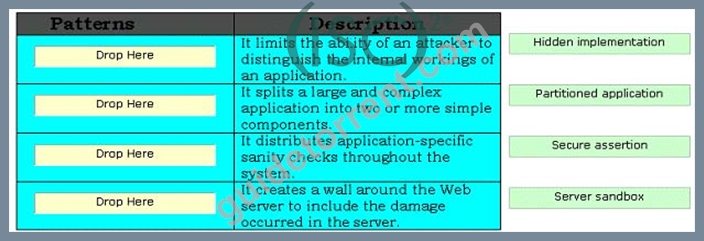
Answer:
Explanation:
Explanation:
The various patterns applicable to software assurance in general are as follows: Hidden implementation: It limits the ability of an attacker to distinguish the internal workings of an application. Partitioned application: It splits a large and complex application into two or more simple components. Secure assertion: It distributes application-specific sanity checks throughout the system. Server sandbox: It creates a wall around the Web server to include the damage that occurs because of an undetected fault in the server or an exploited vulnerability.
NEW QUESTION # 150
Which of the following steps of the LeGrand Vulnerability-Oriented Risk Management method determines the necessary compliance offered by risk management practices and assessment of risk levels?
- A. Assessment, monitoring, and assurance
- B. Vulnerability management
- C. Adherence to security standards and policies for development and deployment
- D. Risk assessment
Answer: A
Explanation:
Assessment, monitoring, and assurance determines the necessary compliance that are offered by risk management practices and assessment of risk levels.
NEW QUESTION # 151
Which of the following phases of the DITSCAP C&A process is used to define the C&A level of effort, to identify the main C&A roles and responsibilities, and to create an agreement on the method for implementing the security requirements?
- A. Phase 1
- B. Phase 3
- C. Phase 4
- D. Phase 2
Answer: A
Explanation:
The Phase 1 of the DITSCAP C&A process is known as Definition Phase. The goal of this phase is to define the C&A level of effort, identify the main C&A roles and responsibilities, and create an agreement on the method for implementing the security requirements. Answer C is incorrect. The Phase 2 of the DITSCAP C&A process is known as Verification. Answer D is incorrect. The Phase 3 of the DITSCAP C&A process is known as Validation. Answer B is incorrect. The Phase 4 of the DITSCAP C&A process is known as Post Accreditation.
NEW QUESTION # 152
Who amongst the following makes the final accreditation decision?
- A. ISSE
- B. ISSO
- C. CRO
- D. DAA
Answer: D
Explanation:
Explanation/Reference:
Explanation: The DAA, also known as Authorizing Official, makes the final accreditation decision. The Designated Approving Authority (DAA), in the United States Department of Defense, is the official with the authority to formally assume responsibility for operating a system at an acceptable level of risk. The DAA is responsible for implementing system security. The DAA can grant the accreditation and can determine that the system's risks are not at an acceptable level and the system is not ready to be operational. AnswerD is incorrect. An Information System Security Officer (ISSO) plays the role of a supporter. The responsibilities of an Information System Security Officer (ISSO) are as follows: Manages the security of the information system that is slated for Certification & Accreditation (C&A). Insures the information systems configuration with the agency's information security policy. Supports the information system owner/information owner for the completion of security-related responsibilities. Takes part in the formal configuration management process. Prepares Certification & Accreditation (C&A) packages. AnswerA is incorrect. An Information System Security Engineer (ISSE) plays the role of an advisor. The responsibilities of an Information System Security Engineer are as follows: Provides view on the continuous monitoring of the information system. Provides advice on the impacts of system changes. Takes part in the configuration management process. Takes part in the development activities that are required to implement system changes. Follows approved system changes. AnswerB is incorrect. A Chief Risk Officer (CRO) is also known as Chief Risk Management Officer (CRMO). The Chief Risk Officer or Chief Risk Management Officer of a corporation is the executive accountable for enabling the efficient and effective governance of significant risks, and related opportunities, to a business and its various segments. Risks are commonly categorized as strategic, reputational, operational, financial, or compliance-related. CRO's are accountable to the Executive Committee and The Board for enabling the business to balance risk and reward. In more complex organizations, they are generally responsible for coordinating the organization's Enterprise Risk Management (ERM) approach.
NEW QUESTION # 153
The IAM/CA makes certification accreditation recommendations to the DAA. The DAA issues accreditation determinations. Which of the following are the accreditation determinations issued by the DAA? Each correct answer represents a complete solution. Choose all that apply.
- A. DATO
- B. IATT
- C. ATO
- D. IATO
- E. ATT
Answer: A,B,C,D
Explanation:
Explanation/Reference:
Explanation: The DAA issues one of the following four accreditation determinations: Approval to Operate (ATO): It is an authorization of a DoD information system to process, store, or transmit information. Interim Approval to Operate (IATO): It is a temporary approval to operate based on an assessment of the implementation status of the assigned IA Controls. Interim Approval to Test (IATT): It is a temporary approval to conduct system testing based on an assessment of the implementation status of the assigned IA Controls. Denial of Approval to Operate (DATO): It is a determination that a DoD information system cannot operate because of an inadequate IA design or failure to implement assigned IA Controls. Answer:
E is incorrect. No such type of accreditation determination exists.
NEW QUESTION # 154
FITSAF stands for Federal Information Technology Security Assessment Framework. It is a methodology for assessing the security of information systems. Which of the following FITSAF levels shows that the procedures and controls have been implemented?
- A. Level 5
- B. Level 2
- C. Level 4
- D. Level 3
- E. Level 1
Answer: D
Explanation:
Explanation/Reference:
Explanation: The following are the five levels of FITSAF based on SEI's Capability Maturity Model (CMM):
Level 1: The first level reflects that an asset has documented a security policy. Level 2: The second level shows that the asset has documented procedures and controls to implement the policy. Level 3: The third level indicates that these procedures and controls have been implemented. Level 4: The fourth level shows that the procedures and controls are tested and reviewed. Level 5: The fifth level is the final level and shows that the asset has procedures and controls fully integrated into a comprehensive program.
NEW QUESTION # 155
You are responsible for network and information security at a metropolitan police station. The most important concern is that unauthorized parties are not able to access data. What is this called?
- A. Integrity
- B. Encryption
- C. Availability
- D. Confidentiality
Answer: D
Explanation:
The CIA (Confidentiality, Integrity, and Availability) triangle is concerned with three facets of security. Confidentiality is the concern that data be secure from unauthorized access. Answer B and C are incorrect. The CIA (Confidentiality, Integrity, and Availability) triangle is concerned with three facets of security. Integrity is the concern that data not be altered without it being traceable. Availability is the concern that the data, while being secured, is readily accessible. Answer D is incorrect. Confidentiality may be implemented with encryption but encryption is just a technique to obtain confidentiality.
NEW QUESTION # 156
Which of the following processes describes the elements such as quantity, quality, coverage, timelines, and availability, and categorizes the different functions that the system will need to perform in order to gather the documented mission/business needs?
- A. Operational scenarios
- B. Functional requirements
- C. Performance requirements
- D. Human factors
Answer: B
Explanation:
Explanation/Reference:
Explanation: The functional requirements categorize the different functions that the system will need to perform in order to gather the documented mission/business needs. The functional requirements describe the elements such as quantity, quality, coverage, timelines, and availability.
AnswerC is incorrect. The performance requirements comprise of speed, throughput, accuracy, humidity
tolerances, mechanical stresses such as vibrations or noises. AnswerA is incorrect. Human factor consists of factors, which affect the operation of the system or component, such as design space, eye movement, or ergonomics. AnswerD is incorrect. The operational scenarios provide assistance to the system designers and form the basis of major events in the acquisition phases, such as testing the products for system integration. The customer classifies and defines the operational scenarios, which indicate the range of anticipated uses of system products.
NEW QUESTION # 157
A number of security patterns for Web applications under the DARPA contract have been developed by Kienzle, Elder, Tyree, and Edwards-Hewitt. Which of the following patterns are applicable to aspects of authentication in Web applications?b Each correct answer represents a complete solution. Choose all that apply.
- A. Secure assertion
- B. Account lockout
- C. Authenticated session
- D. Password propagation
- E. Partitioned application
- F. Password authentication
Answer: B,C,D,F
Explanation:
The various patterns applicable to aspects of authentication in the Web applications are as follows: Account lockout: It implements a limit on the incorrect password attempts to protect an account from automated password-guessing attacks. Authenticated session: It allows a user to access more than one access-restricted Web page without re-authenticating every page. It also integrates user authentication into the basic session model. Password authentication: It provides protection against weak passwords, automated password-guessing attacks, and mishandling of passwords. Password propagation: It offers a choice by requiring that a user's authentication credentials be verified by the database before providing access to that user's data. Answer B and C are incorrect. Secure assertion and partitioned application patterns are applicable to software assurance in general.
NEW QUESTION # 158
Which of the following are the levels of public or commercial data classification system? Each correct answer represents a complete solution. Choose all that apply.
- A. Secret
- B. Sensitive
- C. Confidential
- D. Public
- E. Private
- F. Unclassified
Answer: B,C,D,E
Explanation:
Explanation/Reference:
Explanation: The public or commercial data classification is also built upon a four-level model, which are as follows: Public Sensitive Private Confidential Each level (top to bottom) represents an increasing level of sensitivity. The public level is similar to unclassified level military classification system. This level of data should not cause any damage if disclosed. Sensitive is a higher level of classification than public level data. This level of data requires a greater level of protection to maintain confidentiality. The Private level of data is intended for company use only. Disclosure of this level of data can damage the company. The Confidential level of data is considered very sensitive and is intended for internal use only. Disclosure of this level of data can cause serious damage to the company. AnswerC and E are incorrect. Unclassified and secret are the levels of military data classification.
NEW QUESTION # 159
You work as a security engineer for BlueWell Inc. According to you, which of the following DITSCAP/ NIACAP model phases occurs at the initiation of the project, or at the initial C&A effort of a legacy system?
- A. Verification
- B. Definition
- C. Post Accreditation
- D. Validation
Answer: B
Explanation:
Explanation/Reference:
Explanation: The definition phase of the DITSCAP/NIACAP model takes place at the beginning of the project, or at the initial C&A effort of a legacy system. C&A consists of four phases in a DITSCAP assessment. These phases are the same as NIACAP phases. The order of these phases is as follows:
1.Definition: The definition phase is focused on understanding the IS business case, the mission, environment, and architecture. This phase determines the security requirements and level of effort necessary to achieve Certification & Accreditation (C&A). 2.Verification: The second phase confirms the evolving or modified system's compliance with the information. The verification phase ensures that the fully integrated system will be ready for certification testing. 3.Validation: The third phase confirms abidance of the fully integrated system with the security policy. This phase follows the requirements slated in the SSAA. The objective of the validation phase is to show the required evidence to support the DAA in accreditation process. 4.Post Accreditation: The Post Accreditation is the final phase of DITSCAP assessment and it starts after the system has been certified and accredited for operations. This phase ensures secure system management, operation, and maintenance to save an acceptable level of residual risk.
NEW QUESTION # 160
Which of the following terms ensures that no intentional or unintentional unauthorized modification is made to data?
- A. Integrity
- B. Non-repudiation
- C. Confidentiality
- D. Authentication
Answer: A
Explanation:
Integrity ensures that no intentional or unintentional unauthorized modification is made to data. Answer D is incorrect. Confidentiality refers to the protection of data against unauthorized access. Administrators can provide confidentiality by encrypting data. Answer A is incorrect. Non-repudiation is a mechanism to prove that the sender really sent this message. Answer C is incorrect. Authentication is the process of verifying the identity of a person or network host.
NEW QUESTION # 161
Which of the following phases of NIST SP 800-37 C&A methodology examines the residual risk for acceptability, and prepares the final security accreditation package?
- A. Continuous Monitoring
- B. Security Certification
- C. Initiation
- D. Security Accreditation
Answer: D
Explanation:
The various phases of NIST SP 800-37 C&A are as follows: Phase 1: Initiation- This phase includes preparation, notification and resource identification. It performs the security plan analysis, update, and acceptance. Phase 2: Security Certification- The Security certification phase evaluates the controls and documentation. Phase 3: Security Accreditation- The security accreditation phase examines the residual risk for acceptability, and prepares the final security accreditation package. Phase 4: Continuous Monitoring-This phase monitors the configuration management and control, ongoing security control verification, and status reporting and documentation.
NEW QUESTION # 162
Which of the following types of activities can be audited for security? Each correct answer represents a complete solution. Choose three.
- A. Network logons and logoffs
- B. Printer access
- C. File and object access
- D. Data downloading from the Internet
Answer: A,B,C
Explanation:
The following types of activities can be audited: Network logons and logoffs File access Printer access Remote access service Application usage Network services Auditing is used to track user accounts for file and object access, logon attempts, system shutdown, etc. This enhances the security of the network. Before enabling security auditing, the type of event to be audited should be specified in the audit policy. Auditing is an essential component to maintain the security of deployed systems. Security auditing depends on the criticality of the environment and on the company's security policy. The security system should be reviewed periodically. Answer B is incorrect. Data downloading from the Internet cannot be audited.
NEW QUESTION # 163
Which of the following terms refers to a mechanism which proves that the sender really sent a particular message?
- A. Integrity
- B. Confidentiality
- C. Authentication
- D. Non-repudiation
Answer: D
Explanation:
Explanation/Reference:
Explanation: Non-repudiation is a mechanism which proves that the sender really sent a message. It provides an evidence of the identity of the senderand message integrity. It also prevents a person from denying the submission or delivery of the message and the integrity of its contents. AnswerC is incorrect.
Authentication is a process of verifying the identity of a person or network host. AnswerA is incorrect.
Confidentiality ensures that no one can read a message except the intended receiver. AnswerD is incorrect. Integrity assures the receiver that the received message has not been altered in any way from the original.
NEW QUESTION # 164
In digital rights management, the level of robustness depends on the various types of tools and attacks to which they must be resistant or immune. Which of the following types of tools are expensive, require skill, and are not easily available?
- A. Hand tools
- B. Professional tools
- C. Widely available tools
- D. Specialized tools
Answer: B
Explanation:
Explanation/Reference:
Explanation: The tools used in DRM to define the level of robustness are as follows: 1.Widely available tools: These tools are easy to use and are available to everyone. For example, screw-drivers and file editors. 2.Specialized tools: These tools require skill and are available at reasonable prices. For example, debuggers, decompilers, and memory scanners. 3.Professional tools: These tools are expensive, require skill, and are not easily available. For example, logic analyzers, circuit emulators, and chip disassembly systems.
NEW QUESTION # 165
......
Pass ISC CSSLP Exam in First Attempt Guaranteed: https://www.guidetorrent.com/CSSLP-pdf-free-download.html