
Best IFC Exam Dumps for the Preparation of Latest IFC Exam Questions
Download Latest & Valid Questions For CISI IFC exam
CISI IFC Exam Syllabus Topics:
| Topic | Details |
|---|---|
| Topic 1 |
|
| Topic 2 |
|
| Topic 3 |
|
| Topic 4 |
|
NEW QUESTION # 114
Your client, Rinaldo, wants to know more about the fees associated with his mutual funds. What can you tell him about a mutual fund's management expense ratio (MER)?
- A. Trailer and brokerage fees are charged separately from the MER.
- B. Mutual funds are required to calculate the MER on a daily basis.
- C. Mutual fund performance is not impacted by the MER since rates of return are published net of fees.
- D. The MER reflects the percentage of each dollar of fund assets that is used to pay for management services.
Answer: D
Explanation:
C is correct because the management expense ratio (MER) reflects the percentage of each dollar of fund assets that is used to pay for management services and operating expenses of a mutual fund. The MER includes various fees and expenses, such as management fees, administration fees, trailer fees, audit fees, legal fees, and taxes. The MER reduces the return of the fund, as it is deducted from the fund's income and capital gains before they are distributed to investors. Mutual funds are not required to calculate the MER on a daily basis (A), but rather on an annual basis. Trailer and brokerage fees are included in the MER (B), not charged separately. Mutual fund performance is impacted by the MER (D), as it lowers the net return of the fund. Rates of return are published net of fees, but they do not reflect the impact of the MER on the fund's performance.
NEW QUESTION # 115
Last year, a hedge fund had a gross return of 22%. The hurdle rate was 5%, and the incentive fee was 20%.
What percentage compensation would the fund manager earn for this strategy, assuming no other fees exist?
- A. 5.4%
- B. 3.0%
- C. 4.4%
- D. 3.4%
Answer: D
Explanation:
Hedge fund incentive fees apply only to returns above the hurdle rate.
Gross return = 22%
Hurdle rate = 5%
Excess return = 22% # 5% = 17%
Incentive fee = 20% × 17% = 3.4%
Thus, the fund manager earns 3.4% compensation.
NEW QUESTION # 116
What may be used to determine which of two bond portfolios is more sensitive to interest rate changes?
- A. Variance
- B. Time-weighted maturity
- C. Beta
- D. Sharpe
Answer: B
Explanation:
The sensitivity of a bond or bond portfolio to interest rate changes is measured by duration, also called time- weighted maturity.
Duration represents the approximate % change in bond price for a 1% change in interest rates.
Higher duration = greater sensitivity to interest rate movements.
Therefore, the correct measure is Time-weighted maturity (Duration).
NEW QUESTION # 117
Fund A has a 5-year average return of 10% and a standard deviation of 5%. Fund B has a 5-year average return of 8% and a standard deviation of 2%. Select the most accurate statement about Funds A and B.
- A. Fund B's lowest return is lower than Fund A's lowest return
- B. Fund A's returns have ranged from 5% to 10%
- C. Fund B is less risky than Fund A
- D. Fund A will always provide a higher return than Fund B
Answer: C
Explanation:
Comprehensive and Detailed Explanation From Exact Extract:
A lower standard deviation indicates lower volatility and thus lower risk. Fund B, with a standard deviation of
2%, is less risky than Fund A, with a standard deviation of 5%. The feedback from the document states:
"We can find the probable range of returns as follows: Average Return + Standard deviation = Positive outcome. Average Return - Standard deviation = Negative outcome. In any given year Fund A, which has the higher standard deviation, could fluctuate much more widely, making it less attractive as an investment, even over the long-term. Volatility is the most common measure of risk." Reference:Chapter 8 - Constructing Investment PortfoliosLearning Domain:Understanding Investment Products and Portfolios
NEW QUESTION # 118
What type of mutual fund can invest in specified derivatives and forward contracts for grains, meats, metals, energy products, and coffee?
- A. global equity fund
- B. specialty fund
- C. labour-sponsored investment fund
- D. commodity pool
Answer: D
Explanation:
A commodity pool is a type of mutual fund that can invest in specified derivatives and forward contracts for commodities, such as grains, meats, metals, energy products, and coffee. A commodity pool allows investors to gain exposure to the commodity markets without having to buy or sell the physical commodities themselves. A commodity pool may also use leverage and hedging strategies to enhance returns and reduce risks. Therefore, B is the correct answer. References: Commodity Pool: Definition and How It Works - Investopedia, Canadian Investment Funds Course (CIFC) | IFSE Institute
NEW QUESTION # 119
For the last year, an investor earned a return before adjustment for inflation of 2% on a money market fund, while inflation averaged 1.5%. What was his nominal rate of return?
- A. 2.00%
- B. 0.50%
- C. 3.50%
- D. 1.50%
Answer: A
Explanation:
Comprehensive and Detailed Explanation From Exact Extract:
The nominal rate of return is the return before adjustment for inflation, which is given as 2%. The real rate of return would be adjusted for inflation (2% - 1.5% = 0.5%), but the question asks for the nominal rate. The feedback from the document states:
"It is important to consider the effects of inflation on investments because we can isolate the difference between nominal and real returns. Investors are more concerned with the real rate of return - the return adjusted for the effects of inflation. A nominal return is a return that has not been adjusted for the impact of inflation. The approximate real rate of return is calculated as: Real Return = Nominal Rate - Annual Inflation Rate." Reference:Chapter 8 - Constructing Investment PortfoliosLearning Domain:Understanding Investment Products and Portfolios
NEW QUESTION # 120
Stan, a portfolio manager, is looking at two steel companies as potential investments. Truesteel Inc. has a current ratio of 2:1 while Strongco Ltd. has a current ratio of 0.8:1.
What could this information indicate?
- A. Stronqco is reiving less on debt financing than Truesteel.
- B. Truesteel is better able to meet its short-term financial obligations than Strongco.
- C. The stock market is more optimistic about the prospects for Truesteel than Strongco.
- D. It appears that Truesteel is more profitable than Strongco.
Answer: B
Explanation:
The current ratio is a liquidity ratio that measures a company's ability to pay its short-term obligations with its current assets. A higher current ratio indicates that the company has more current assets than current liabilities, which means it can meet its short-term obligations more easily. A lower current ratio indicates that the company has less current assets than current liabilities, which means it may face liquidity problems or default risk. Therefore, the information given in the question indicates that Truesteel is better able to meet its short-term financial obligations than Strongco. The current ratio does not necessarily reflect the profitability, market outlook, or debt financing of the companies. References: Current Ratio Explained With Formula and Examples, Current Ratio Formula, Current ratio
NEW QUESTION # 121
What amount of Canadian taxes would an investor with a 33% marginal tax rate pay on a $5,000 dividend payment from a foreign corporation?
- A. $1,650
- B. $825
- C. $1,241
- D. $0
Answer: A
Explanation: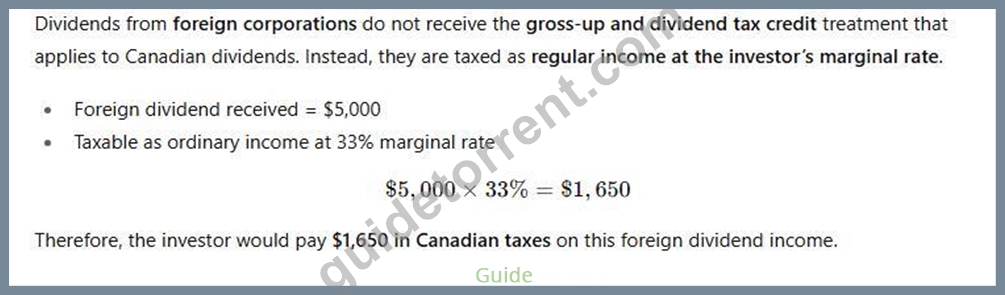
NEW QUESTION # 122
Francis wants to redeem his US Asset Allocation Fund as he needs the money for a down payment for a home purchase. The current proceeds from the redemption are USD $27,859, and the current CAD/USD exchange rate is 0.7353.
How much will Francis receive in Canadian dollars when he redeems the Funds? Please round your answer to the nearest dollar.
- A. $36,698
- B. $42,861
- C. $35,859
- D. $37,888
Answer: D
Explanation:
A is correct because Francis will receive $37,888 in Canadian dollars when he redeems the Funds. This is calculated by dividing the current proceeds from the redemption in US dollars by the current CAD/USD exchange rate and rounding to the nearest dollar. That is,
NEW QUESTION # 123
Which among the following BEST describes a company's retained earnings statement?
- A. a company's financial position at a specific point in time
- B. the amount of money contributed to the company by its shareholders or owners
- C. the earnings and expenses of a business over a period of time
- D. the amount of profit that is reinvested in the company
Answer: D
Explanation:
A company's retained earnings statement is a financial statement that shows how the company's net income is distributed between dividends paid to shareholders and retained earnings, which are the amount of profit that is reinvested in the company. Retained earnings are part of the company's equity, and they reflect the accumulated earnings that the company has generated over its history, minus any dividends or distributions.
Retained earnings can be used by the company for various purposes, such as expanding its operations, developing new products, paying off debt, or buying back shares1 References = Canadian Investment Funds Course, Unit 5: Types of Investments, Lesson 3: Equity Securities, Section 5.3.4: Financial Statements
NEW QUESTION # 124
What is the level of risk associated with a mortgage fund compared to other types of funds?
- A. More risk than a money market fund, but less risk than a bond fund
- B. More risk than a precious metals fund, but less risk than a specialty fund
- C. More risk than a balanced fund, but less risk than a real estate fund
- D. More risk than a dividend fund, but less risk than an equity fund
Answer: D
Explanation:
The correct answer is D. More risk than a dividend fund, but less risk than an equity fund. The Investment Funds in Canada curriculum explains that mortgage funds invest primarily in residential and commercial mortgages, generating income from interest payments.
Mortgage funds carry credit risk, interest rate risk, and liquidity risk, making them riskier than traditional dividend or fixed-income funds, which often hold publicly traded securities. However, they are generally less volatile than equity funds, which are subject to broader market fluctuations and business risk.
Dividend funds typically invest in established companies with stable cash flows and are therefore less risky than mortgage funds. Equity funds expose investors to full market risk and price volatility, placing them at a higher risk level than mortgage funds.
The CIFC course places mortgage funds in the mid-risk spectrum, between income-oriented equity funds and growth-oriented equity funds. Therefore, Option D is the correct and fully CIFC-verified answer.
NEW QUESTION # 125
Which feature would be of prime importance for a money market mutual fund?
- A. Liquidity
- B. Yield
- C. Tax efficiency
- D. Inflationary hedge
Answer: A
Explanation:
The correct answer is C. Liquidity. According to the Investment Funds in Canada curriculum, the primary objectives of money market mutual funds are capital preservation and liquidity, with income as a secondary consideration. Money market funds invest in short-term, high-quality debt instruments such as treasury bills, bankers' acceptances, and commercial paper, which mature in less than one year.
The CIFC text emphasizes that money market funds are designed to provide investors with easy access to cash, making liquidity their most important feature. These funds typically maintain a stable net asset value per unit (NAVPU), allowing investors to redeem units quickly with minimal price fluctuation.
Tax efficiency is not a defining feature of money market funds, as interest income is fully taxable in non- registered accounts. Money market funds also do not provide an inflation hedge because returns are generally modest and may not keep pace with rising prices. Yield is intentionally low relative to other asset classes because higher yields usually require higher risk, which contradicts the fund's conservative mandate.
Because liquidity is the cornerstone of money market fund design and suitability, Option C is the correct and fully CIFC-verified answer.
NEW QUESTION # 126
Which of the following applies to a mutual fund trust?
- A. It is not efficient at passing through income to investors.
- B. It has unitholders.
- C. It has a board of directors and shareholders.
- D. It is always closed-end.
Answer: B
Explanation:
A mutual fund trust is a type of unit trust that meets certain conditions under the Canadian Income Tax Act and is eligible for favourable tax treatment. A unit trust is a collective investment vehicle that holds assets and distributes profits to individual unit owners, also called unitholders, instead of reinvesting them in the fund. A mutual fund trust is not a corporation and does not have a board of directors or shareholders. It is also not a closed-end fund, which has a fixed number of shares that trade on an exchange. A mutual fund trust is an open-end fund, which can issue and redeem units at any time based on the net asset value of the fund.
1: Canadian Investment Funds Course, Unit 5, Section 5.1
NEW QUESTION # 127
Which of the following applies to a mutual fund trust?
- A. It is not efficient at passing through income to investors.
- B. It has unitholders.
- C. It has a board of directors and shareholders.
- D. It is always closed-end.
Answer: B
Explanation:
A mutual fund trust is a type of unit trust that meets certain conditions under the Canadian Income Tax Act and is eligible for favourable tax treatment. A unit trust is a collective investment vehicle that holds assets and distributes profits to individual unit owners, also called unitholders, instead of reinvesting them in the fund. A mutual fund trust is not a corporation and does not have a board of directors or shareholders. It is also not a closed-end fund, which has a fixed number of shares that trade on an exchange. A mutual fund trust is an open-end fund, which can issue and redeem units at any time based on the net asset value of the fund.
Canadian Investment Funds Course, Unit 5, Section 5.1
NEW QUESTION # 128
An investor, whose marginal tax rate is 29%, owns non-registered units of a fund that have a beginning and ending NAVPS of $21.50 and $25.50, respectively. The inflation rate is 2%. Assuming dividends are reinvested and ignoring additions or withdrawals, what is the before-tax, one-year rate of return?
- A. 15.69%
- B. 16.60%
- C. 13.21%
- D. 18.60%
Answer: D
Explanation:
The correct answer is B. 18.60%. The Investment Funds in Canada course defines the before-tax rate of return as the percentage change in investment value over a period, excluding taxes and inflation adjustments.
The formula for calculating the holding period return is:
Because the question specifically asks for the before-tax rate of return, the investor's marginal tax rate and inflation rate are not applied. Inflation would be used to calculate a real rate of return, and taxes would be used for an after-tax return, neither of which is requested here.
The CIFC curriculum stresses that investors must clearly distinguish between nominal, real, before-tax, and after-tax returns when evaluating performance. Since the calculation strictly reflects price appreciation,
18.60% is the correct answer.
Therefore, Option B is fully verified and CIFC-aligned.
NEW QUESTION # 129
During the calendar year, Firmansyah received a $1,800 eligible dividend from a large Canadian bank and a
$US dollar (USD) dividend of $882.02 from a foreign-based corporation. The USD/CAD exchange rates is
1.3605.
Firmansyah's federal marginal tax bracket is 29%. The enhanced dividend gross-up rate is 38% and the federal dividend tax credit rate for eligible dividends is 15%.
What federal tax liability will be result from his investment income?
- A. $695.76
- B. $348.00
- C. $870.00
- D. $522.00
Answer: A
Explanation:
To calculate the federal tax liability from the investment income, we need to consider the following steps:
* Convert the foreign dividend to Canadian dollars using the exchange rate.In this case, $882.02 USD x
1.3605 = $1,200.00 CAD.
* Gross up the eligible dividend by the enhanced dividend gross-up rate of 38%.In this case, $1,800 x
1.38 = $2,484.
* Add the grossed-up eligible dividend and the foreign dividend to get the total taxable income from dividends.In this case, $2,484 + $1,200 = $3,684.
* Multiply the total taxable income from dividends by the federal marginal tax rate of 29% to get the gross federal tax payable.In this case, $3,684 x 0.29 = $1,068.36.
* Multiply the grossed-up eligible dividend by the federal dividend tax credit rate of 15% to get the federal dividend tax credit.In this case, $2,484 x 0.15 = $372.60.
* Subtract the federal dividend tax credit from the gross federal tax payable to get the net federal tax liability.In this case, $1,068.36 - $372.60 = $695.76.
Therefore, Firmansyah's federal tax liability from his investment income is $695.76.
1: Canadian Investment Funds Course - IFSE Institute 2 (Unit 9: Retirement)
NEW QUESTION # 130
Last year at age 70, Gregory opened a registered retirement income fund (RRIF). Recently, Gregory unexpectedly received a large cash gift and presently does not need to depend on any payments from his RRIF. He contacts his financial advisor Eric for guidance.
Which of the following statements by his financial advisor would be CORRECT?
- A. Gregory's account will be subjected to no maximum withdrawal limit but to an annual minimum withdrawal.
- B. Withdrawals become mandatory within the first year of the plan being started.
- C. Periodic contributions to a RRIF are permitted until Gregory reaches the age of 71.
- D. Gregory must have attained the minimum age of 71 to open a RRIF.
Answer: A
Explanation:
According to the Canadian Investment Funds Course, a registered retirement income fund (RRIF) is a type of registered plan that provides a stream of income in retirement. A RRIF can be opened at any age, but it must be established by the end of the year the annuitant turns 71. A RRIF cannot accept any contributions, but it can receive transfers from other registered plans, such as RRSPs, PRPPs, RPPs, or other RRIFs. A RRIF has no maximum withdrawal limit, meaning that the annuitant can withdraw any amount from the plan at any time. However, a RRIF has a minimum withdrawal requirement, which is calculated based on the annuitant's age or the age of their spouse or common-law partner. The minimum withdrawal must be paid out in the year following the year the RRIF is opened and every year thereafter. The minimum withdrawal is taxable as income in the year of receipt.
Therefore, the correct answer is C. Gregory's account will be subjected to no maximum withdrawal limit but to an annual minimum withdrawal.
1: Canadian Investment Funds Course - IFSE Institute 2 (Unit 9: Retirement)
NEW QUESTION # 131
Armand, a financial advisor, recently met with Austin, a potential client. Austin is interested in a conservative portfolio that focuses on mature companies that are out of favour with a low turnover. What is the best investment philosophy for Austin?
- A. Momentum strategy
- B. Growth at a reasonable price
- C. Value style
- D. Growth investing
Answer: C
NEW QUESTION # 132
Your client, a high-income earner in a high marginal tax bracket, is seeking to minimize the amount of tax he pays on investment income while continuing to invest in mutual funds. Which mutual fund would best meet his investment objective?
- A. Fixed-income fund
- B. Money market fund
- C. Foreign equity fund
- D. Canadian equity fund
Answer: D
Explanation:
Comprehensive and Detailed Explanation From Exact Extract:
Canadian equity funds are tax-efficient for high-income earners as they generate dividends and capital gains, which are taxed at lower rates than interest income. The feedback from the document states:
"Of the funds listed, the most tax-effective would be a Canadian equity fund because it should generate some dividends and some capital gains. Money market funds and fixed income funds would each generate highly taxed interest income, while a foreign equity fund would not generate tax-advantaged Canadian dividend income or capital gains. Before recommending an equity fund, the mutual fund representative should ensure that the fund is suitable for his client because equity funds have a higher risk profile than funds that generate interest income." Reference:Chapter 6 - Tax and Retirement PlanningLearning Domain:The Know Your Client Communication Process
NEW QUESTION # 133
What type of GIC would be most appropriate for an investor who believes equity markets will be strong in the next five years?
- A. Index-linked
- B. Laddered
- C. Interest-rate-linked
- D. Cashable
Answer: A
Explanation:
The correct answer is B. Index-linked. The Investment Funds in Canada curriculum explains that index- linked GICs provide returns tied to the performance of an underlying equity index while still offering principal protection.
For investors who expect strong equity market performance but want to avoid direct market risk, index-linked GICs allow participation in market upside without risking principal loss. Laddered and cashable GICs emphasize liquidity and interest-rate management, not equity growth. Interest-rate-linked GICs respond to interest rate changes, not equity markets.
The CIFC text highlights index-linked GICs as suitable for investors seeking growth potential with capital protection, making them ideal when equity markets are expected to perform well. Therefore, Option B is the correct and fully CIFC-aligned answer.
NEW QUESTION # 134
Which of the following are obligations on mutual fund dealing representatives imposed by The Proceeds of Crime (Money Laundering) and Terrorist Financing Act?
- A. reporting all financial transactions to the Financial Transactions and Reports Analysis Centre of Canada (FINTRAC)
- B. confirming client identity each time before concluding any transaction
- C. enhancing public awareness of matters related to money laundering and terrorist financing
- D. record-keeping of large transactions, account-related information, and other relevant records
Answer: D
NEW QUESTION # 135
......
Exam Materials for You to Prepare & Pass IFC Exam: https://www.guidetorrent.com/IFC-pdf-free-download.html
Ensure Success With Updated Verified IFC Exam Dumps: https://drive.google.com/open?id=1AFYurjLsaKCkVmmZVB4NX1E5F4OfCrLU