
NEW 2025 Certification Sample Questions AD0-E724 Dumps & Practice Exam
AD0-E724 Deluxe Study Guide with Online Test Engine
NEW QUESTION # 86
On an Adobe Commerce Cloud platform, at what level is the variable env: composer_auth located in the Project Web Interface?
- A. In the Project variables.
- B. In the Integration variables.
- C. In the Environment-specific variables.
Answer: A
Explanation:
The variable env: composer_auth is located in the Project variables section in the Project Web Interface. This variable is used to store the authentication credentials for Composer repositories that require access keys or tokens. The developer can set this variable at the project level to apply it to all environments, or override it at the environment level if needed. Verified References: [Magento 2.4 DevDocs] 2
NEW QUESTION # 87
An Adobe Commerce developer is tasked with adding an new export option for the order grid, they have added the following code for the export button within sales_order_grid.xml: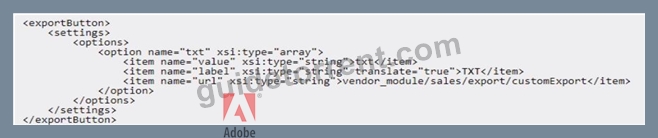
Upon testing, they are getting redirected, what would be a cause for this error?
- A. The option's uri attribute is not valid.
- B. The developer has to add a formkey for the new export option.
- C. The layout cache needs to be refreshed.
Answer: B
Explanation:
The developer has to add a formkey for the new export option because the formkey is required for security reasons. Without the formkey, the request will be rejected and redirected to the dashboard page. Verified References: [Magento 2.4 User Guide] [Magento 2.4 DevDocs] When adding custom export options to grids in Magento, it's crucial to include a form key for actions that involve form submission. Magento relies on form keys for CSRF (Cross-Site Request Forgery) protection, so omitting the form key can lead to redirects or failed operations.
* Form Key Requirement:
* In Magento, the form key is a hidden token included in forms to ensure that the request is valid.
This is particularly important for actions that change the state or export data, as it helps prevent unauthorized actions.
* Adding a custom export button triggers a form submission, which requires a valid form key.
Without it, Magento may redirect to a default page or the admin dashboard as a security measure.
* Why Option C is Correct:
* Option C correctly identifies the lack of a form key as the issue. When Magento detects a missing form key in sensitive operations, it defaults to a redirect to maintain security.
* Option A, concerning the URI, is less likely to cause a redirection. Similarly, Option B regarding layout cache would not directly impact CSRF validation, which is the cause of the redirection here.
* Solution:
* Modify the button or form submission logic to include a form key, typically by adding form_key=
{{formKey}} in the URL parameters or within the form data.
NEW QUESTION # 88
Which index mode is valid?
- A. Update on refresh
- B. Update on invalidate
- C. Update on save
Answer: C
Explanation:
"Update on save" is a valid index mode in Magento, where the index is set to update automatically whenever a change is saved. This mode ensures that the index remains up-to-date with the latest data changes, such as product or category updates, immediately reflecting these changes on the storefront. This real-time indexing is crucial for maintaining data accuracy and consistency across the Magento site, especially in dynamic environments with frequent updates.
NEW QUESTION # 89
An Adobe Commerce developer is writing an integration test. They checked some Integration Tests for Magento core modules for reference and noticed that they use data fixtures initialized by adding annotations to test classes. For example:
The developer wants to add their own fixture to test a MyVendor_MyModule they created. Which steps will make this possible?
- A. Option B
- B. Option A
- C. 1. Create a PHP file With the fixture data in [magento root dir]/dev/tests/integration/testsuite/MyVendor
/MyModule/_files/my_fixture.php.
2. Add the following annotation to the test method:
- D. 1. Create a PHP file with the fixture data inside their own module in [module dir]/Test/integration/_fiies
/my_fixture.php.
2. Add the following annotation to the test method:
- E. Option C
- F. 1. Create a PHP file with the fixture data inside their own module in [module dir]/Test/integration/_f iies
/my_f ixture.php.
2. Add the following annotation to the test method:
Answer: D
Explanation:
* Magento Integration Test Fixtures:
* Integration tests in Magento often require test data to be set up using fixtures.
* Fixtures are typically PHP scripts placed within a _files directory, which Magento looks for based on the module structure and path specified in the annotation.
* Directory Structure for Module-Specific Fixtures:
* The correct approach is to create the fixture within the module's own directory. The path follows:
[module dir]/Test/Integration/_files/.
* By placing it within the module directory, the fixture remains encapsulated and portable with the module itself.
* Annotation Usage in Option A:
* The @magentoDataFixture annotation specifies the path relative to the module directory.
* In this case, using MyVendor_MyModule::Test/Integration/_files/my_fixture.php tells Magento to look within the module's integration test folder, ensuring modularity and easier maintenance.
* Why Other Options Are Incorrect:
* Option B: Storing fixtures in [magento root dir]/dev/tests/integration/testsuite/ is an older approach and does not follow module encapsulation best practices. It is better suited for Magento core modules rather than custom modules.
* Option C: This option uses a similar path structure to Option A, but the provided annotation format lacks proper naming convention. It misses the proper path specification that is necessary for Magento to resolve the fixture correctly.
NEW QUESTION # 90
Which two attribute input types does Magento already have by default? (Choose two.)
- A. Text Field
- B. Multiple Select
- C. Geographic coordinate
- D. Numeric Field
Answer: A,B
Explanation:
The two attribute input types that Adobe Commerce already has by default are Multiple Select and Text Field.
Multiple Select allows the user to select multiple values from a list of options. Text Field allows the user to enter text in a single line.
The Geographic coordinate and Numeric Field input types do not exist in Adobe Commerce.
Verified References: [Adobe Commerce User Guide - Create a product attribute] Magento, by default, provides various attribute input types to accommodate different data entry needs for product and customer attributes. The "Text Field" input type allows for single-line text input, suitable for short, textual data such as names, titles, or any other brief information. The "Multiple Select" input type enables the selection of multiple options from a predefined list, useful for attributes with multiple applicable values like colors, sizes, or features. These input types are part of Magento's flexible attribute system, allowing for customizable data entry fields that cater to diverse product and customer data requirements.
NEW QUESTION # 91
During database migration in the Adobe Commerce Cloud integration environment, a developer experienced a disk space error causing the database import to fail.
How would the developer fix this issue?
- A. Add a new database node and enable split database.
- B. Increase the disk space of the database service.
- C. Change the database engine to PostgreSQL that has no disk space limit.
Answer: B
Explanation:
The developer can fix this issue by increasing the disk space of the database service. The database service is one of the services that run on the Adobe Commerce Cloud platform and provide functionality for the application. The database service uses MySQL as the database engine andstores data for products, customers, orders, etc. The disk space of the database service determines how much data can be stored and processed by the database. If the disk space is insufficient, the database import can fail with a disk space error. The developer can increase the disk space of the database service by modifying the .magento/services.yaml file and redeploying the environment. Verified References: [Magento 2.4 DevDocs]
NEW QUESTION # 92
What is the correct way to inject CMS block in a layout?
- A. <block class="Magento\Cms\Block\Block" name="blockjdentifier"> <arguments> q <argumentname=" block_id"xsi:type="string">my_cms_block_identifier</argument> </arguments> </block>
- B. <block class="Magento\Cms\Block\Block" name="block_identifier"> q <actionmethod=" setBlock'>my_cms_block_identifier</action> </block>
- C. <referenceBlock name="content"> <block class="Magento\Cms\Block\Block" name="block_identifier' identifier="my_cms_block_ldentrfier" /> </referenceBlock>
Answer: A
Explanation:
The correct way to inject a CMS block into a layout in Adobe Commerce is by using the<block>element with the classMagento\Cms\Block\Blockand specifying the block identifier through an<argument>element with the name "block_id". This is shown in option A. The<block>tag defines the block class and name, and the< arguments>tag contains child<argument>tags for each argument, where the "block_id" argument specifies the identifier of the CMS block to be injected.
NEW QUESTION # 93
An Adobe Commerce developer has installed a module from a third-party vendor. This module fires a custom event named third_party_event_after and also defines an observer named third_party_event_after_observer that listens to that event. The developer wants to listen to this custom event in their own module but wants to execute their observer's logic after the third_party_event_after_observer observer has finished executing.
What would the developer do to ensure their observer runs after the observer defined by the third-party module?
- A. Ensure the third-party module is listed in the <sequence> node of the developer's module.xmi file.
- B. This is not possible as observers listening to the same event may be invoked in any order.
- C. Set the sort order of the new observer to be less than that of the third-party vendor's observer.
Answer: B
Explanation:
https://developer.adobe.com/commerce/php/best-practices/extensions/observers/#do-not-rely-on-invocation- order
NEW QUESTION # 94
An Adobe Commerce developer is tasked with adding custom data to orders fetched from the API. While keeping best practices in mind, how would the developer achieve this?
- A. Create an extension attribute on Nagento\sales\Api\E)ata\orderinterface and an after plugin on Magento\Sales\Model\Order: :getExtensionAttributes() to add the custom data.
- B. Create an extension attribute On Magento\Sales\Api\Data\OrderInterface and an after plugin On Magento\Sales\Api\OrderRepositoryInterface On geto and getListo to add the custom data.
- C. Create a before plugin on Magento\sales\model\ResourceModel\order\collection: :load and alter the query to fetch the additional data. Data will then be automatically added to the items fetched from the API.
Answer: B
Explanation:
The developer should create an extension attribute on theMagento\Sales\Api\Data\OrderInterfaceinterface and an after plugin on theMagento\Sales\Api\OrderRepositoryInterface::get() andMagento\Sales\Api\OrderRepositoryInterface::getList()methods.
The extension attribute will store the custom data. The after plugin will be used to add the custom data to the order object when it is fetched from the API.
Here is the code for the extension attribute and after plugin:
PHP
namespace MyVendor\MyModule\Api\Data;
interface OrderExtensionInterface extends \Magento\Sales\Api\Data\OrderInterface
{
/**
* Get custom data.
* * @return string|null
*/
public function getCustomData();
/**
* Set custom data.
* * @param string $customData
* @return $this
*/
public function setCustomData($customData);
}
namespace MyVendor\MyModule\Model;
class OrderRepository extends \Magento\Sales\Api\OrderRepositoryInterface
{
/**
* After get order.
* * @param \Magento\Sales\Api\OrderRepositoryInterface $subject
* @param \Magento\Sales\Api\Data\OrderInterface $order
* @return \Magento\Sales\Api\Data\OrderInterface
*/
public function afterGetOrder($subject, $order)
{
if ($order instanceof OrderExtensionInterface) {
$order->setCustomData('This is custom data');
}
return $order;
}
/**
* After get list.
* * @param \Magento\Sales\Api\OrderRepositoryInterface $subject
* @param \Magento\Sales\Api\Data\OrderInterface[] $orders
* @return \Magento\Sales\Api\Data\OrderInterface[]
*/
public function afterGetList($subject, $orders)
{
foreach ($orders as $order) {
if ($order instanceof OrderExtensionInterface) {
$order->setCustomData('This is custom data');
}
}
return $orders;
}
}
Once the extension attribute and after plugin are created, the custom data will be added to orders fetched from the API.
NEW QUESTION # 95
Which characteristic is associated with a persistent cart?
- A. While the customer is logged in, If the session cookie expires, the persistent cookie will remain active
- B. By default, a persistent cookie will become inactive in 30 days.
- C. While using the persistent cart, guest users do not need to log in or register to checkout
Answer: A
Explanation:
A persistent cart is a cookie that is stored on the customer's computer. This cookie allows the customer to continue shopping even if they close their browser. If the customer is logged in, the persistent cookie will remain active even if the session cookie expires.
Associated with a persistent cart in Adobe Commerce is the characteristic that while the customer is logged in, if the session cookie expires, the persistent cookie will remain active. This ensures that the customer's shopping cart is preserved even if they have been inactive and the session has expired. The persistent cookie allows the cart to be restored when the customer returns to the store.
NEW QUESTION # 96
A developer has informed the Adobe Support team about a planned traffic surge on an Adobe Commerce Cloud project that will take place in a little over 48 hours.
What is an advantage of this prior notice?
- A. When the traffic arrives, extra server resources will be available.
- B. The project will temporarily use an upgraded Fastly plan
- C. The Support team will monitor the website during that time
Answer: C
Explanation:
Informing the Adobe Support team about a planned traffic surge allows them to monitor the website during that time. With prior notice, the support team can ensure that they are prepared to quickly respond to any issues that arise due to the surge. While extra server resources or an upgraded Fastly plan may be possible outcomes, the primary advantage of advance notice is proactive monitoring and support during expected high traffic events.
NEW QUESTION # 97
What is the default store ID for the admin panel?
- A. 0
- B. 1
- C. 2
Answer: B
Explanation:
In Magento, the default store ID for the admin panel is 0. This is used as a fallback mechanism where, if the current store view's ID is not 0, Magento automatically adds 0 as a fallback. This ensures that the admin panel has a unique identifier, differentiating it from the frontend store views, which typically start with IDs higher than 0. This setup is crucial for Magento's multi-store architecture, allowing for distinct configurations and behaviors between the admin and frontend contexts.
NEW QUESTION # 98
A developer would like to initialize a theme in Adobe Commerce. Which two files are required to complete this task? (Choose two.)
- A. theme.less
- B. themexml
- C. composerjson
- D. registration.php
Answer: C,D
Explanation:
To initialize a theme in Adobe Commerce, at least two files are required:registration.phpandtheme.xml. The registration.phpfile is used to register the theme within the system, andtheme.xmldefines the theme's name, parent (if any), and other metadata. Thetheme.lessfile is not required for theme initialization but may be used for custom styling. The correct option fortheme.xmlis represented as "theme.xml" (D), not "themexml" as mentioned in the options.
NEW QUESTION # 99
What folder would a developer place a custom patch on an Adobe Commerce Cloud project to have it automatically applied during the build phase?
- A. Add the patch file to the m2-hotfixes/ directory
- B. Add the patch file to the patches/ directory
- C. Add the patch file to the m2-patches/ directory
Answer: A
Explanation:
On an Adobe Commerce Cloud project, a custom patch should be placed in them2-hotfixes/directory to have it automatically applied during the build phase. The patches in this directory are applied in alphabetical order and can be used to apply quick fixes to the code that will be included in the build artifact.
NEW QUESTION # 100
A seller would like to offer an electronic version of an album by selling each song individually. Which layout can be used to customize a product page layout for this item?
- A. catalog_product_view_category
- B. catalog_product_view_type_configurable
- C. catalog_product_view_type_downloadable
Answer: C
Explanation:
Thecatalog_product_view_type_downloadablelayout can be used to customize a product page layout for a downloadable product. This layout includes the product details, the product reviews, and the download links for the product's files.
For selling electronic versions of albums with individual songs, the downloadable product type in Adobe Commerce is appropriate. To customize the product page layout specifically for downloadable items, the layout handlecatalog_product_view_type_downloadableis used. This layout handle allows developers to target downloadable products specifically and apply custom layouts or templates, making option A correct.
NEW QUESTION # 101
A developer is creating a class \Vendor\Module\Model\MyModeL How should that class be defined as transient in di.xml?
- A. <type name="\Vendor\Module\Model\MyModer singleton='false7>
- B. <type name="\Vendor\Module\Model\MyModer transient="true7>
- C. <type name='\Vendor\Module\Model\MyModer shared="false7>
Answer: C
Explanation:
To define a class as transient in Magento'sdi.xml, the correct approach is to set thesharedattribute to "false" for that class. This tells Magento's object manager not to use the singleton pattern for this class, meaning a new instance will be created each time the class is requested. This is particularly useful for classes that should not maintain state across different areas of the application or during a single request lifecycle.
NEW QUESTION # 102
Which type of product has the ability to build customizable products from a variety of options?
- A. Grouped
- B. Bundle
- C. Virtual
Answer: B
Explanation:
A bundle product is a product that is made up of a collection of other products. This type of product is ideal for selling products that are often purchased together, such as a printer and ink cartridges.
A bundle product in Adobe Commerce has the ability to build customizable products from a variety of options. Bundle products are ideal for creating custom kits or packages where customers can choose from options for each component. For example, building a custom computer setup from selected components like monitors, keyboards, CPUs, etc. Grouped products are collections of standalone products that can be purchased individually, and virtual products are intangible items.
NEW QUESTION # 103
An Adobe Commerce developer is developing a custom module. As part of their implementation they have decided that all instances of their Custom\Module\Model\Example class should receive a new instance of Magento\Filesystem\Adapter\Local.
How would the developer achieve this using di. xml?
- A.

- B.

- C.

Answer: C
NEW QUESTION # 104
......
AD0-E724 dumps review - Professional Quiz Study Materials: https://www.guidetorrent.com/AD0-E724-pdf-free-download.html
AD0-E724 Test Prep Training Practice Exam Questions Practice Tests: https://drive.google.com/open?id=1dkGrSNWD6C8yGB30pxVIYdR2cPu8n7I_