


Your study environment changes from day to day; your material should follow. GuideTorrent offers the SOA Design & Architecture Lab question bank as a printable PDF, a Windows test engine, and a browser-based engine — the same S90.09 practice questions in every format.
SOA S90.09 Exam Overview:
| Certification Vendor: | Arcitura Education |
|---|---|
| Exam Name: | SOA Design & Architecture Lab |
| Exam Number: | S90.09 (also S90.09A) |
| Related Certifications: | Certified Microservices Architect Certified SOA Consultant Certified SOA Security Specialist |
| Exam Duration: | 90–100 |
| Exam Price: | $295 USD |
| Available Languages: | English |
| Passing Score: | 70% or 700/1000 |
| Certificate Validity Period: | 3 years |
| Real Exam Qty: | 40–70 |
| Exam Format: | Lab exercises, Scenario-based, Drag-and-drop, Design tasks, Case studies |
| Recommended Training: | SOA School Official Training SOACP Module 9 Study Kit |
| Exam Registration: | Pearson VUE Scheduling Arcitura Official Exam Registration |
| Sample Questions: |  |
| Exam Way: | Online proctored or onsite at Pearson VUE testing centers |
| Pre Condition: | Recommended: S90.01, S90.02, S90.03, S90.04, S90.05, S90.08 or equivalent knowledge; strong practical experience in SOA design |
| Official Syllabus URL: | https://www.arcitura.com/soacp-gen-1/exams/ |
SOA S90.09 Exam Syllabus Topics:
| Section | Weight | Objectives |
|---|---|---|
| Service Composition & Orchestration | 20% | - Integration & messaging patterns - Orchestration vs choreography - Composition logic & workflow design |
| SOA Governance & Security | 15% | - Scalability, reliability & performance design - Security considerations in architectural design - Design-time governance & standards compliance |
| SOA Design Principles & Patterns | 30% | - Granularity, versioning & dependency management - Standard service-orientation design patterns - Loose coupling, autonomy, reusability, composability |
| Deployment & Architecture Assessment | 10% | - SOA blueprint & enterprise architecture alignment - Trade-off analysis & decision justification |
| Service-Oriented Analysis & Design | 25% | - Requirements analysis & service identification - Service contract & interface design - Service modeling & categorization |
The SOA S90.09 Exam, Question by Question
The S90.09 exam is how SOA decides who earns the Certified SOA Architect, SOA Certified Professional (SOACP) certification, which sits at the Expert / Advanced level. It measures practical command of the SOA Design & Architecture Lab objectives — the skills you'd actually use on the job — which is why it carries weight with employers in a competitive market. It's also part of a wider certification family that includes Certified SOA Consultant, Certified SOA Security Specialist, Certified Microservices Architect, so the effort you invest here keeps paying off as you advance. Candidates do best when they treat the exam as a skills check, not a memory test.
SOA organizes the SOA Design & Architecture Lab syllabus into 5 domains, opening with SOA Design Principles & Patterns (30%), Service Composition & Orchestration (20%), and Deployment & Architecture Assessment (10%). Those weightings are a gift: they tell you where the points concentrate, so you can front-load the domains that decide your score. The full breakdown lives in the exam topics section above — build your study plan around it.
Expect 40–70 questions within 90–100 on the SOA Design & Architecture Lab exam. Treat that ratio as a pacing contract: work out your per-question budget now, and during the exam, flag anything that threatens to overrun it and circle back later. Candidates who rehearse this under a real timer — the GuideTorrent test engine runs one on every mock exam — consistently finish with time to review instead of guessing through the final questions.
You'll need 70% or 700/1000 to pass the SOA Design & Architecture Lab exam, and a seat costs $295 USD. Since retakes bill the full fee again, the economics are simple: arrive over-prepared. The reliable method is timed self-testing — run GuideTorrent practice exams until your scores sit clearly above the passing mark across several sessions, then register. You're not buying certainty; you're refusing to pay for the same exam twice.
SOA lists the SOA Design & Architecture Lab question types as: Scenario-based, Lab exercises, Drag-and-drop, Design tasks, Case studies. Knowing the list is half the battle; the other half is practicing against each type until its mechanics are boring. For lengthy scenario items, anchor on the actual question sentence before digesting the stem. GuideTorrent's 40 practice questions cover these formats, so nothing on your screen in the exam room is a first encounter.
The SOA Design & Architecture Lab exam is currently available in English. Pick the language where your reading speed is highest — in a timed exam, comprehension pace quietly decides borderline scores. If you're testing in English, GuideTorrent's English-language S90.09 practice questions double as drills for the exact terminology SOA favors.
Passing the SOA Design & Architecture Lab exam earns you a credential that stays valid for 3 years. Put the expiry date somewhere you'll see it — renewal is painless when planned and painful when discovered late. Because SOA owns the recertification policy and revises it from time to time, check the official certification page well before your renewal window opens.
All three versions carry the same 40 expert-researched questions — pick the experience, not the content:
- PDF version — printable and expert-prepared, with instant download access. Study anywhere, anytime, on any device. Includes 365 days of free updates and a free demo.
- Desktop Test Engine — Windows software recreating the real exam environment, with two practice modes, offline access, and no installation limits.
- Online Test Engine — any browser, any device: Windows, Mac, Android, iOS. Tracks your test history and reviews your performance over time.
Working professionals usually settle into a rhythm: PDF sessions on weekdays, timed engine runs on weekends.
Yes — and we encourage it. GuideTorrent's free SOA Design & Architecture Lab PDF demo shows you genuine sample questions and full verified answers before any payment. Every purchase then includes 365 days of free updates, with renewal afterward at 50% off from your member zone. Judge the material first; that's what the demo is for.
Our research team has tracked the SOA Design & Architecture Lab exam for years, and the question bank is revised continuously as SOA shifts what's tested — not on an annual schedule. Purchases include 365 days of free updates via your member zone, and you can watch for releases through the New Releases section or the GuideTorrent newsletter. Re-check 3-4 days before your exam date, and if a product ever expires, repurchasing at 50% off restarts the update flow.
Transactions are protected by McAfee security services end to end. Your personal information is never shared with third parties, the only email you'll receive comes directly from GuideTorrent, and you can leave our mailing list with a single request. A fast checkout shouldn't mean a risky one — here, it's both fast and locked down.
Delivery is effectively instant: your SOA Design & Architecture Lab practice questions are downloadable immediately and emailed within one minute of payment — if 2 hours go by, check spam and contact support. Installation is unlimited across your computers. If the exam doesn't go your way, the 100% Money Back Guarantee applies: take the corresponding exam within 60 days of purchase, and if you don't pass, submit a scanned enrollment slip and your official Score Report PDF within 2 days after the exam for a full refund processed within 7 days. Exclusions: attempts within 3 days of purchase, exams never actually taken, free items, expired orders — and candidate and payer names must match. Rather stay in the fight? Exchange for two free exam products of equal value and keep your update service running.
What You Get with GuideTorrent for SOA Design & Architecture Lab
A preparation system, not just a file. Judge the quality first with the free demo; once you buy, your S90.09 material is in your inbox within one minute of payment (contact support if 2 hours pass), installs on unlimited computers, and stays current through 365 days of free updates. Transactions are protected by McAfee security services, and your personal information is never shared with third parties.
- Update service: 365 days free; expired products repurchase at a 50% discount from your member zone.
- 100% Money Back Guarantee: take the corresponding exam within 60 days of purchase, and if you don't pass, submit your enrollment slip and official Score Report within 2 days after the exam for a full refund processed within 7 days — or exchange for two free products of equal value.
The decision takes minutes and the payoff lasts a career: download the free S90.09 demo today, and let GuideTorrent's 40 practice questions carry your SOA Design & Architecture Lab preparation from first session to passing score.
SOA Design & Architecture Lab Sample Questions:
Service A is a task service that is required to carry out a series of updates to a set of
databases in order to complete a task. To perform the database updates Service A must
interact with three other services, each of which provides standardized data access
capabilities.
Service A sends its first update request message to Service B (1), which then responds
with a message containing a success or failure code (2). Service A then sends its second
update request message to Service C (3), which also responds with a message containing
a success or failure code (4). Finally, Service A sends a request message to Service D (5),
which responds with its own message containing a success or failure code (6).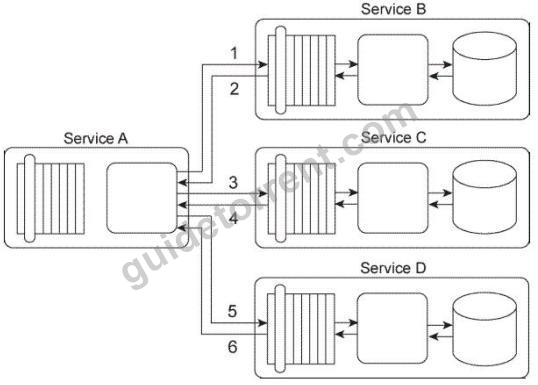
You've been asked to change this service composition architecture in order to fulfill a set of
new requirements: First, if the database update performed by Service B fails, then it must
be logged by Service A.
Secondly, if the database update performed by Service C fails,
then a notification e-mail must be sent out to a human administrator. Third, if the database
update performed by either Service C or Service D fails, then both of these updates must
be reversed so that the respective databases are restored back to their original states.
What steps can be taken to fulfill these requirements?
- A. The Compensating Service Transaction pattern is applied to Service B so that it invokes
exception handling logic that logs failed database updates before responding with a failure
code back to Service A . Similarly, the Compensating Service Transaction pattern is
applied to Service C so that it issues an e-mail notification to a human administrator when a
database update fails. The Atomic Service Transaction pattern is applied so that Services
A, C, and D are encompassed in the scope of a transaction that will guarantee that if the
database updates performed by either Service C or Service D fails, then both updates will
be rolled back. The Service Autonomy principle is further applied to Service A to ensure
that it remains consistently available to carry out this sequence of actions. - B. The Atomic Service Transaction pattern is applied so that Services A, C, and D are
encompassed in the scope of a transaction that will guarantee that if the database updates
performed by either Service C or Service D fails, then both updates will be rolled back. The
Compensating Service Transaction pattern is then applied to all services so that the scope
of the compensating transaction includes the scope of the atomic transaction. The
compensating exception logic that is added to Service D automatically invokes Service B to
log the failure condition and Service C to issue the e-mail notification to the human
administrator. This way, it is guaranteed that the compensating logic is always executed
together with the atomic transaction logic. - C. Service A is updated to perform a logging routine when Service A receives a response
message from Service B containing a failure code. Service A is further updated to send an
e-mail notification to a human administrator if Service A receives a response message from
Service C containing a failure code. The Atomic Service Transaction pattern is applied so
that Services A, C, and D are encompassed in the scope of a transaction that will
guarantee that if the database updates performed by either Service C or Service D fails,
then both updates will be rolled back. - D. None of the above.
Correct Answer: C 🗳️
Service A has become increasingly difficult to maintain. Its core service logic has become
bloated and convoluted because it has been updated numerous times during which
additional functionality was added to interact with the database and the legacy system and
to support interaction with Service Consumers A and B (via the two service contracts) as
well as interaction directly with Service Consumer C.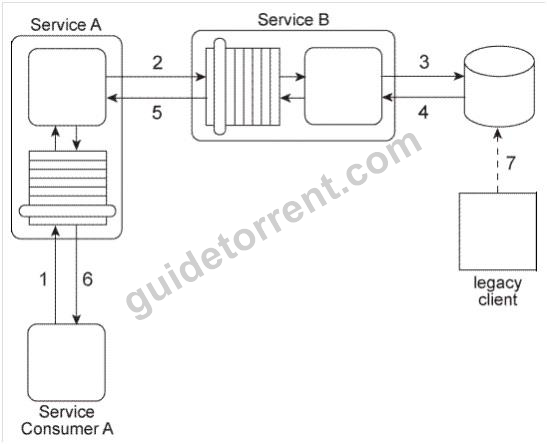
What steps can be taken to solve these problems and to prevent them from happening
again in the future?
- A. The Service Facade pattern can be applied to position a Facade component between
the core service logic and the implementation resources (the database and the legacy
system) and to also position a Facade component between the two service contracts and
Service Consumers A and - B. None of the above.
- C. The Official Endpoint pattern can be applied to limit access to Service A to one of its two
published service contracts. The Service Loose Coupling principle can be applied so that
Service Consumer C does not negatively couple itself directly to the core service logic of
Service A . B.
The Service Facade pattern can be applied to position a Facade component
between the core service logic and the implementation resources (the database and the
legacy system) and to position a faade component between the core service logic and the
two service contracts. The Contract Centralization pattern can be applied to limit access to
Service A to one of its two published service contracts. The Service Abstraction principle
can be applied to hide the implementation details of Service A from service consumers. - D. The Service Faade pattern can be applied to position a Facade component between the
core service logic and the two service contracts. The Contract Centralization pattern can be
applied to limit access to Service A to one of its two published service contracts. The
Service Loose Coupling principle can be applied so that Service Consumer C does not
negatively couple itself directly to the core service logic of Service A .
Correct Answer: C 🗳️
Service A is a utility service that provides generic data access logic to a database that
contains data that is periodically replicated from a shared database (1). Because the
Standardized Service Contract principle was applied to the design of Service A, its service
contract has been fully standardized.
Service A is being accessed by three service consumers. Service Consumer A accesses a
component that is part of the Service A implementation by invoking it directly (2). Service
Consumer B invokes Service A by accessing its service contract (3). Service Consumer C
directly accesses the replicated database that is part of the Service A implementation (4).
You've been told that the reason Service Consumers A and C bypass the published
Service A service contract is because, for security reasons, they are not allowed to access
a subset of the operations in the WSDL definition that expresses the service contract. How
can the Service A architecture be changed to enforce these security restrictions while
avoiding negative forms of coupling?
- A. The Contract Centralization pattern can be applied to force service consumers to access
the Service A architecture via its published service contract only. The Service Loose
Coupling principle can then be applied to ensure that the centralized service contract does
not contain any content that is dependent on or derived from the underlying service
implementation. - B. The Concurrent Contracts pattern can be applied to Service A in order to establish one
or more alternative service contracts. This allows service consumers with different levels of
security clearance to continue accessing the service logic via its published service
contracts. - C. None of the above.
- D. The Contract Centralization pattern can be applied to force all service consumers to
access the Service A architecture via its published service contract. This will prevent
negative forms of coupling that could lead to problems when the database is replaced. The
Service Abstraction principle can then be applied to hide underlying service architecture
details so that future service consumers cannot be designed to access any part of the
underlying service implementation.
Correct Answer: B 🗳️
It has been confirmed that Policy A and Policy B are, in fact, the same policy and that the
security credential check performed by Service Agent B also needs to be carried out on
messages sent to Service B .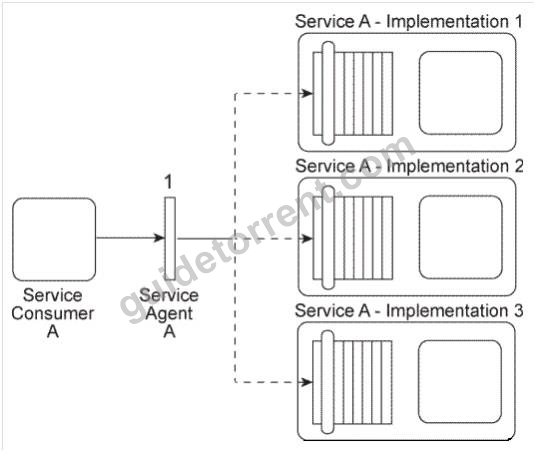
How can this service composition architecture be changed to reduce the redundancy of
policy content and fulfill the new security requirement?
- A. The Policy Centralization pattern can be applied so that Policy A and Policy B are
combined into the same policy. The Service Agent pattern is then applied to introduce a
new service agent (called Service Agent D) which carries out the validation and
enforcement of Policy A and Policy B.
Service Agent B can be moved so that it performs
the security credential check for Service B, but not for Service A . - B. The Policy Centralization pattern can be applied so that Policy A and Policy B are
combined into the same policy. The policy enforcement logic is removed from Service
Agent C and Service Agent A is then used to enforce the policy for messages sent to
Service A and Service B . Service Agent B can be used to perform the security credential
check for Service A and Service B . - C. None of the above.
- D. The Policy Centralization pattern can be applied so that Service Agent A is changed to
enforce the policy for messages sent to Service A and Service B and to perform the
security credential check for Service A and Service B .
Correct Answer: B 🗳️
Viewing page 1 out of 10 pages.
Viewing questions 1-4 out of 40 questions.


